1. Introduction: The Rising Popularity of Multi-Functional Training Racks in Home Fitness
In recent years, home fitness has evolved from a casual lifestyle trend into a standardized, long-term health management system. More fitness users are abandoning single-function equipment with low utilization and choosing integrated, space-saving, and high-scalability strength training equipment. Among all home gym core devices, the multi-functional training rack stands out as the most cost-effective and versatile solution, gradually replacing traditional separate squat racks, independent cable machines, single training benches, and scattered auxiliary fitness gear. However, many users still face a key confusion: is a comprehensive multi-functional training rack necessary for their fitness level? Is it too professional for complete beginners, or too basic for advanced bodybuilding enthusiasts?
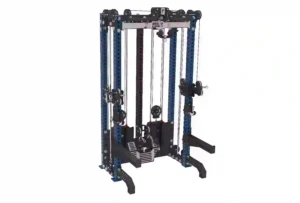
A multi-functional training rack integrates a free-weight squat rack structure, adjustable cable system, pull-up station, multi-angle bench support, and diversified auxiliary training modules. It combines the core advantages of traditional squat racks and independent cable machines, taking into account heavy compound strength training and precise isolated muscle shaping training. This dual-functional integration makes its applicable crowd extremely wide, covering zero-based fitness beginners, intermediate fitness enthusiasts, professional bodybuilding practitioners, and even small boutique studio gyms. Nevertheless, different groups have completely different demand logic, usage focus, and value perception for multi-functional training racks.
Many merchants blindly hype the all-purpose attributes of multi-functional racks, leading many beginners to follow the trend and buy high-configured equipment that they cannot use, resulting in long-term idle waste. Meanwhile, some advanced bodybuilding enthusiasts underestimate the comprehensive performance of modern multi-functional training racks, stubbornly pursuing split commercial equipment combinations and causing excessive budget and space waste. To solve this information asymmetry, this article will conduct in-depth demand analysis for fitness beginners and bodybuilding enthusiasts, clarify the applicable scenarios, functional matching degree, training value, and purchase standards of multi-functional training racks for different crowds, and help users accurately judge whether this equipment is suitable for their long-term fitness plans.
2. Core Composition & Dual Training Mechanism of Multi-Functional Training Racks
To accurately analyze crowd matching degree, we first need to clarify the core structural composition and dual training logic of multi-functional training racks. Different from single-function equipment, qualified multi-functional training racks adopt a dual-core design of free-weight frame + cable constant tension system, covering two mainstream strength training modes in the fitness industry, which is the fundamental reason why it can adapt to users of all levels.
2.1 Squat Rack Free-Weight System: Variable Tension for Foundation Strength Building
The main frame of the multi-functional training rack inherits the classic commercial squat rack structure, equipped with adjustable J-hooks, safety spotter arms, thickened stable steel frame and pull-up bar. It supports all free-weight compound movements including barbell squats, bench presses, overhead presses, deadlifts, and pull-ups. This free-weight training mode relies on gravity to generate variable tension, which changes continuously with the movement angle and muscle contraction state, conforming to the natural force curve of human muscles.
Variable tension compound training can mobilize multiple large muscle groups such as legs, chest, back, and shoulders to work synergistically, while activating deep core stabilizer muscles that are difficult to stimulate by single equipment. It is the most effective training mode to improve absolute strength, increase basic muscle mass, enhance basal metabolism, and build a solid physical foundation. This part of the function perfectly meets the strength growth needs of bodybuilding enthusiasts and solves the problem of weak physical foundation of fitness beginners.
2.2 Cable Machine Functional Training: Constant Tension & Precise Isolated Stimulation
The biggest core advantage of cable machines is full-range constant tension output. Different from free weight variable tension, the cable traction resistance remains stable throughout the entire stretching and contracting process of muscles, completely eliminating training dead points. This continuous tension greatly prolongs muscle time under tension (TUT), the core scientific indicator of muscle hypertrophy, and can significantly improve muscle shaping fineness and muscle separation.
The multi-angle adjustable pulley design of the cable machine can break the single vertical force limitation of gravity training, realize three-dimensional force in horizontal, inclined and vertical directions, and accurately target small and difficult-to-stimulate muscle groups such as rear deltoids, inner pectoral muscles, latissimus dorsi edges and abdominal oblique muscles. Its standardized movement track can avoid auxiliary muscle involvement, realize pure isolated training of target muscles, and effectively correct muscle imbalance and unbalanced physique problems caused by long-term free weight training.
2.3 Dual-System Complementary Advantages of Integrated Racks
The integrated design of the multi-functional training rack perfectly combines the free-weight strength foundation of the squat rack and the constant-tension fine shaping of the cable machine. It abandons the single function defect of traditional equipment, realizing “one machine for foundation building and detail polishing”. For beginners, it provides low-threshold adaptive training and safe strength improvement channels; for bodybuilding enthusiasts, it supports progressive overload compound training and high-precision muscle detail shaping, with extremely high crowd compatibility and training scalability.
3. Training Safety and Adaptability Differences for Different User Groups
Training safety and operation threshold are important indicators to distinguish whether equipment is suitable for beginners and senior enthusiasts. Multi-functional training racks have natural hierarchical adaptation characteristics in terms of safety protection and operation difficulty, which can perfectly cover the needs of users with different technical levels.
3.1 Beginner-Oriented Low-Threshold Safety Design
In terms of training safety, cable machines have natural advantages. The smooth and stable cable traction has no inertial swing impact force, which can buffer joint pressure, protect knee joints, shoulder joints and lumbar spine, and is suitable for beginner adaptive training, sports injury rehabilitation training and long-term high-frequency fine training. Even if the movement is slightly irregular, it will not cause excessive joint load and strain.
The multi-functional training rack retains the low-risk training characteristics of the cable system, allowing beginners to start with low-resistance isolated movements to standardize muscle force perception and movement posture, avoiding sports injuries caused by premature contact with heavy free weights. At the same time, the built-in safety limit structure of the squat rack frame can effectively prevent barbell falling accidents, solving the safety pain points of beginners training alone at home.
3.2 Senior User-Oriented High-Load Breaking Performance
Squat rack free weight training has high requirements for movement standardization and core stability. Unstandardized posture and excessive load will easily cause instantaneous overload on the spine, knee joints and shoulder ligaments, leading to chronic sports injuries. However, its high stability and anti-fall safety structure can support near-limit heavy-load training, helping users break strength bottlenecks, which is the core advantage that cable machines do not have.
For bodybuilding enthusiasts who have mastered standard movement postures, the multi-functional rack’s free-weight system can support unlimited progressive overload training, continuously break strength and muscle growth bottlenecks, while the cable system assists in polishing muscle separation and detail fullness, meeting the dual needs of senior users for strength breakthrough and physique refinement.
4. Demand Analysis: Why Multi-Functional Racks Are Suitable for Fitness Beginners
Most zero-based fitness beginners have confused fitness goals, limited budget, weak movement control ability, and single training cognition. Traditional single equipment cannot meet their phased growth needs, while multi-functional training racks perfectly fit the whole-cycle growth logic of beginners from entry to steady progress.
4.1 Solving Beginner Pain Points of Single Training Mode
Fitness beginners who only purchase dumbbells or single benches often face the problem of single training movements, unable to carry out systematic full-body training, and it is easy to fall into fitness bottlenecks in the early stage. The multi-functional training rack covers more than 80 kinds of training movements, including whole-body muscle activation, basic strength training, core shaping and posture correction. Rich movement types can maintain beginners’ fitness interest and avoid giving up due to boring single training.
4.2 Low-Threshold Adaptation and Posture Standardization
Beginners lack muscle memory and core control ability, and it is difficult to master heavy barbell compound movements in a short time. The cable constant tension system of the multi-functional rack has a fixed movement track, which can guide users to standardize force angles, help beginners quickly perceive target muscle contraction, establish correct movement memory, and lay a solid foundation for subsequent heavy strength training. Different from free equipment that is easy to deform and cause wrong force, the integrated rack has stable structure and standardized training track, which is very suitable for beginner adaptive training.
4.3 Phased Growth Scalability to Avoid Equipment Replacement Waste
The biggest misunderstanding of beginners’ equipment purchase is pursuing low-price single-function equipment, which will be eliminated with the improvement of fitness level in 3 to 6 months, resulting in repeated investment and budget waste. The multi-functional training rack has strong training scalability. In the early entry stage, users can use cable low-resistance shaping and light-load compound training to adapt; in the middle growth stage, they can increase barbell load for strength improvement; in the later shaping stage, they can match dual-system combined training. One machine covers the whole growth cycle of beginners, with ultra-high long-term cost performance.
4.4 Space and Budget Adaptation for Family Beginners
Most home fitness beginners live in apartments with limited space and have limited initial fitness budget. Purchasing separate squat racks, cable machines and training benches will occupy a large space and cost a lot. The integrated multi-functional rack saves more than 60% of space compared with split equipment, and the one-time investment avoids repeated consumption, which perfectly matches the space and budget constraints of ordinary family beginners.
5. Demand Analysis: Why Multi-Functional Racks Fit Bodybuilding & Fitness Enthusiasts
Intermediate and advanced bodybuilding enthusiasts have clear goals of muscle hypertrophy, strength breakthrough and physique refinement, and have extremely high requirements for training comprehensiveness, progressive overload and muscle stimulation fineness. Many people mistakenly believe that integrated multi-functional racks are household entry-level equipment and cannot meet professional bodybuilding needs. In fact, high-quality commercial-grade multi-functional training racks can fully meet the systematic training needs of bodybuilding enthusiasts, and have unique matching advantages in training logic.
5.1 Meet Compound Strength Training and Muscle Mass Growth Needs
The core positioning of squat racks is heavy compound strength training and basic muscle mass building. Its exclusive advantages are reflected in unlimited progressive overload, multi-muscle synergistic activation and functional strength improvement. The core high-efficiency training items include barbell back squats, front squats, flat bench presses, incline bench presses, overhead presses, conventional deadlifts, Romanian deadlifts and pull-ups. These classic compound movements are the foundation of all strength training, which can efficiently improve overall strength, increase basic muscle mass, enhance body metabolism level, and lay a solid foundation for fat loss and muscle gain.
In addition, the squat rack can be matched with dumbbells, resistance bands and auxiliary training tools to expand diversified training modes, with extremely high training scalability. It is the only equipment suitable for long-term progressive strength breakthrough and professional bodybuilding basic training. For users whose core goal is to gain muscle mass, improve absolute strength and enhance physical fitness, the squat rack part of the multi-functional rack is indispensable core configuration.
5.2 Support Fine Shaping and Muscle Symmetry Correction
The core positioning of cable machines is fine muscle shaping, posture correction and functional muscle training. Its exclusive advantages are full-range constant tension, multi-angle three-dimensional stimulation and unilateral precise correction. The core high-efficiency training items include cable chest flyes, face pulls, straight-arm pulldowns, tricep pushdowns, cable bicep curls, lateral raises, cable woodchoppers and unilateral corrective training.
These isolated and functional movements can polish muscle details, improve muscle fullness and separation, adjust left-right muscle strength balance, correct hunchback, shoulder asymmetry and unbalanced lower limb strength, and shape a symmetrical and three-dimensional fitness physique. At the same time, the low-joint-pressure training mode is suitable for low-threshold daily fitness, beginner entry training and post-injury rehabilitation training, making up for the shortcomings of single training fineness and high injury risk of squat rack training.
5.3 Solve Training Bottlenecks of Single Equipment
Single squat rack training has inherent limitations: insufficient fine muscle stimulation. Free weight compound training focuses on large muscle group development, and it is difficult to accurately target small muscle groups and muscle edges, resulting in insufficient physique fineness and easy formation of bulky but not three-dimensional muscle lines. Second, intermittent muscle tension has training dead points, resulting in insufficient muscle continuous contraction time and limited hypertrophy efficiency in local muscle areas. Third, high training threshold requires standardized posture and core control ability, which is easy to cause wrong force and injury for beginners. Fourth, it cannot correct muscle imbalance. Long-term bilateral synchronous free weight training will enlarge left-right muscle strength differences and aggravate physique asymmetry.
Single cable machine training also has obvious defects: limited upper limit of absolute strength. Affected by the weight stack capacity, the cable machine cannot carry out super heavy load training, and it is difficult to break the overall strength bottleneck, unable to meet the basic strength growth needs of advanced trainers. Second, insufficient compound training efficiency. Single cable training cannot mobilize multiple large muscle groups for synergistic force, and the efficiency of building basic muscle mass is far lower than that of squat rack compound training. Third, insufficient stabilizer muscle activation. The fixed track guiding force makes the core and auxiliary muscle participation low, unable to improve overall functional strength and body coordination.
The multi-functional training rack integrates the advantages of the two and abandons their defects, realizing the perfect combination of heavy compound muscle building and fine isolated shaping, which can effectively help bodybuilding enthusiasts break long-term training bottlenecks.
5.4 Professional Training Collocation for Advanced Fitness Goals
For bodybuilding enthusiasts pursuing comprehensive physique improvement, the multi-functional rack supports the most scientific dual-mode training routine. The first is squat rack main + cable auxiliary routine for muscle gain and strength improvement: complete heavy compound movements such as barbell squats, bench presses and deadlifts first to fully activate large muscle groups and break strength limits; then use the cable machine for isolated shaping and exhaustion training of target muscles. For chest training, complete heavy barbell bench presses first, then cable flyes to squeeze and shape chest muscles; for back training, complete barbell rows and pull-ups first, then cable face pulls and straight-arm pulldowns to polish back muscle lines; for shoulder training, complete barbell overhead presses first, then cable lateral raises and rear delt flyes to make up for insufficient small muscle stimulation.
The second is cable main + squat rack auxiliary routine for shaping and posture correction: use cable multi-angle fine training as the main body and squat rack light-load compound training as the supplement. First, use cable machines for full-body isolated shaping training to activate target muscles and improve muscle tightness; then match light-load barbell compound movements on the squat rack to improve overall muscle coordination and avoid single muscle stiffness. This routine can effectively shape compact muscle lines, correct bad postures, and ensure the symmetry and aesthetics of the physique while losing fat.
6. Inapplicable Crowds and Purchase Misunderstandings to Avoid
Although multi-functional training racks have a wide range of applicable crowds, they are not suitable for all fitness groups. Clarifying inapplicable scenarios can help users avoid blind consumption and equipment waste.
6.1 Inapplicable Crowds
First, casual fitness users with extremely low training frequency. Users who only exercise occasionally and have no systematic fitness plan do not need high-performance multi-functional racks, and simple dumbbells and yoga auxiliary tools can meet their casual exercise needs. Second, pure aerobic fat loss groups who do not pursue strength training. Users who only like running, cycling and aerobic exercise have no demand for strength equipment, and multi-functional racks will be idle for a long time. Third, users with extremely narrow family space who cannot place integrated large equipment.
6.2 Common Purchase and Use Misunderstandings
First, the substitution misunderstanding: thinking that squat racks can completely replace cable machines, resulting in rough muscle lines and unbalanced physique; or thinking that cable machines can replace squat racks, resulting in inability to gain muscle mass and weak basic strength. Second, the priority misunderstanding: blindly pursuing expensive dual equipment configuration in the early stage of fitness, resulting in idle equipment and waste of budget and space. Third, the single training misunderstanding: only using one equipment function for long-term single training, leading to obvious training bottlenecks and slow progress. Fourth, the scenario mismatch misunderstanding: configuring professional multi-functional heavy racks for pure casual fitness, resulting in performance waste.
7. Final Verdict: Exact Crowd Positioning of Multi-Functional Training Racks
After systematic demand analysis and functional matching, we can draw an accurate conclusion on the applicable crowds of multi-functional training racks. For fitness beginners with systematic fitness needs, limited family space and phased growth goals, multi-functional training racks are the most cost-effective entry-level professional equipment, which can solve the pain points of single training, unsafe movement and easy equipment elimination, and accompany users to complete zero-based fitness entry and steady growth.
For intermediate and advanced bodybuilding enthusiasts and professional fitness trainers, high-grade multi-functional training racks are also excellent core training equipment. Its dual-system complementary training mode can meet the dual needs of strength breakthrough and muscle detail shaping, perfectly solve the training bottlenecks of single free-weight or single cable equipment, and support long-term systematic bodybuilding training and physique refinement.
The essence of equipment selection is matching personal fitness stage and goal. Multi-functional training racks are not redundant high-end equipment, nor oversimplified entry-level gadgets. They are universal and scalable professional fitness carriers tailored for most home fitness users, covering the whole cycle needs from beginner entry to advanced bodybuilding.
Adhering to the original intention of original innovation and quality manufacturing, we will keep forging ahead, continuously enhance the brand’s global core competitiveness, let more Chineseinnovative fitness products go global, and continuously transmit the strong innovation power of Chinese fitness brands to the global market, helping the high-quality and sustainable development of the global fitness industry.