
Honeycomb Shade Fabric: A Complete Guide to Performance, Structure and Applications
Honeycomb shade fabric combines light control, thermal …
For buyers, designers & sourcing teams
CategoryUncategorized
Use this article as a technical reference. Contact us if you need fabric samples, specifications or project support.
What Is Honeycomb Shade Fabric?
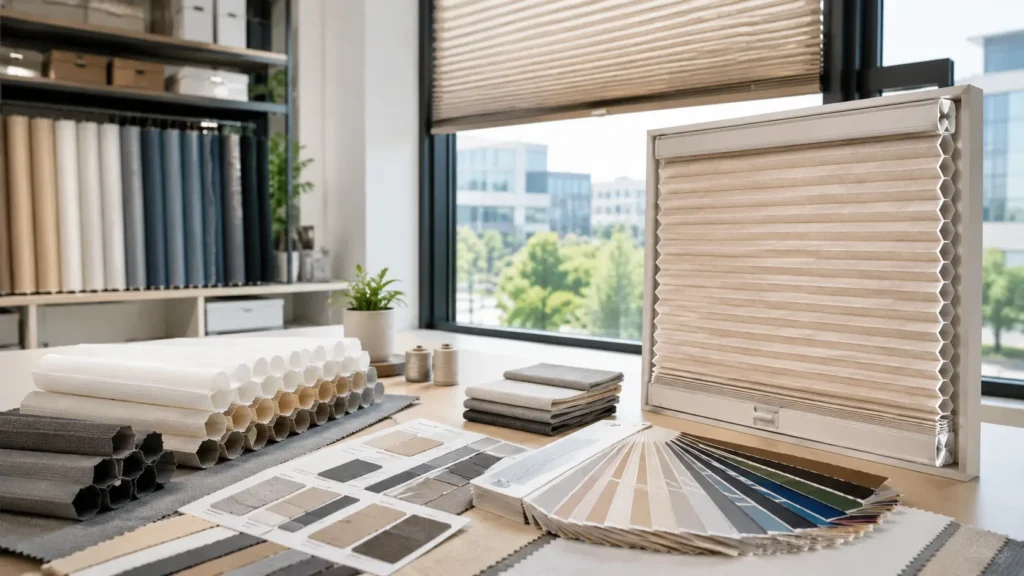
Honeycomb shade fabric, also known as cellular shade fabric, is a specially engineered window covering material designed with a distinctive cellular structure. When the fabric is formed into a shade, the cross-section resembles a honeycomb, creating small air pockets between layers of material.
These air pockets are more than a visual feature. They help improve thermal insulation, reduce heat transfer and contribute to better indoor comfort.
Because of this combination of performance and appearance, honeycomb shade fabric is widely used in residential homes, offices, hotels, commercial buildings and other modern interior spaces.
For manufacturers, wholesalers and window covering brands, selecting the right cellular shade fabric is an important part of achieving consistent pleat retention, light control and long-term product performance.
How Does the Honeycomb Structure Work?
The main difference between cellular shade fabric and conventional flat window covering fabric is its three-dimensional structure.
After processing, the material forms continuous cells across the width of the shade. These cells trap air and create an insulating layer between the window glass and the indoor environment.
This structure can help reduce heat transfer in summer and heat loss in winter.
The cellular design also allows the shade to compress into a relatively small stack when raised, making it suitable for modern window systems where both appearance and functionality are important.
The quality of the finished shade depends heavily on the stability of the fabric, adhesive performance, pleat consistency and manufacturing accuracy.
Light Filtering vs. Blackout Honeycomb Fabric
One of the most important decisions when sourcing honeycomb shade fabric is choosing the correct light-control performance.
Light filtering cellular fabric allows natural daylight to pass through the shade while reducing glare and improving privacy. It is commonly used in living rooms, offices, dining areas and other spaces where soft natural light is preferred.
Blackout cellular fabric is designed to block significantly more external light. Depending on the construction, it may include additional coatings, laminations or inner layers that improve light-blocking performance.
Blackout honeycomb fabrics are commonly used in bedrooms, hotels, meeting rooms, media rooms and other applications requiring stronger privacy and reduced light transmission.
When evaluating a supplier, buyers should not only ask whether a fabric is “blackout” or “light filtering.” It is also useful to confirm the actual construction, color options and intended application.
Single Cell and Double Cell Construction
Honeycomb shades can be produced in different cellular structures.
Single-cell fabric uses one row of air pockets and is commonly selected for general residential and commercial applications. It offers a good balance between weight, insulation, appearance and production efficiency.
Double-cell construction creates additional air chambers, providing greater insulation performance in certain applications.
However, the best structure depends on the shade system, desired appearance, overall product weight and target market.
For OEM and ODM projects, fabric structure should therefore be selected together with the finished shade design rather than as an isolated specification.
Why Pleat Size Matters
Pleat size has a direct influence on the appearance and performance of the finished cellular shade.
Smaller pleats tend to create a finer, more compact appearance, while larger pleats can create a stronger architectural effect on larger windows.
Common pleat dimensions may vary depending on the market and shade system.
When choosing a pleat size, buyers should consider window dimensions, headrail design, fabric thickness and the desired stacking performance.
Consistent pleat formation is especially important for professional window covering manufacturers. Uneven pleats can affect both appearance and the smooth operation of the finished shade.
For this reason, pleat retention and dimensional stability are important quality indicators when evaluating honeycomb shade fabric.
Key Performance Factors for B2B Buyers
When purchasing cellular shade fabric in volume, appearance is only one part of the evaluation.
Professional buyers should also consider material consistency, color consistency, fabric weight, usable width, pleat stability, light-control performance, adhesive compatibility and production repeatability.
For long-term sourcing, batch consistency is particularly important.
A fabric may perform well in a sample but create problems if later production batches differ in shade, thickness or stiffness.
This is why experienced manufacturers normally maintain production standards, quality-control procedures and equipment calibration throughout bulk production.
Stable production capacity is also important for project orders, private-label programs and repeat purchasing.
Common Applications of Cellular Shade Fabric
Honeycomb fabrics are suitable for a wide range of window covering projects, including:
- Residential bedrooms, living rooms and dining areas
- Offices and commercial buildings
- Hotels and hospitality projects
- Schools and institutional buildings
- Large floor-to-ceiling windows
- Custom-made cellular blinds
- Motorized window shade systems
- OEM and private-label window covering programs
The same basic cellular technology can be adapted to different interior requirements by changing color, opacity, pleat structure and fabric construction.
This flexibility makes cellular shade fabric an attractive option for brands that need multiple product levels within one shade category.
Color and Surface Design
Color is one of the most visible factors in a finished shade, but color selection can also influence perceived light transmission and interior atmosphere.
Neutral colors such as white, beige, gray and warm natural tones remain popular because they work with a wide range of interior styles.
Darker shades can create stronger visual contrast and may support specific blackout applications.
For wholesalers and retailers, a well-developed color card is useful because it allows one fabric construction to support multiple market preferences.
When developing a product collection, buyers may request custom colors or select from an existing swatch range depending on MOQ and production requirements.
Choosing a Honeycomb Shade Fabric Supplier
For B2B buyers, the supplier should be evaluated as a manufacturing partner rather than simply as a fabric seller.
Production equipment, quality control, development capability, customization support and order capacity all influence long-term sourcing reliability.
A capable supplier should be able to provide clear product specifications, color samples, technical information and consistent communication throughout sampling and bulk production.
OEM and ODM capabilities are also valuable for buyers who require customized colors, structures, packaging or finished shade solutions.
Before placing a large order, requesting physical samples is recommended.
Samples allow buyers to evaluate texture, color, pleat stability, light transmission and overall suitability for their target shade system.
Honeycomb Shade Fabric for Modern Window Coverings
As energy efficiency, indoor comfort and modern interior design continue to influence the window covering industry, cellular shades remain an important product category.
Their combination of insulation, privacy, light control and compact stacking performance makes them suitable for both residential and commercial markets.
For manufacturers and distributors, the most successful products depend on selecting the correct fabric construction and maintaining stable quality across production.
A well-engineered honeycomb shade fabric can help improve the performance, appearance and market positioning of the finished window covering.
Looking for Honeycomb Shade Fabric?
If you are sourcing honeycomb shade fabric for wholesale, OEM, ODM or window covering projects, we can provide fabric options for different pleat sizes, colors and light-control requirements.
Contact us with your required specifications, estimated quantity and application to receive suitable fabric recommendations and sample support.
Need help choosing the right cellular shade fabric?
Send us your application, light-control requirement, pleat size and estimated quantity. We can recommend suitable fabrics and sample options.
Related Articles
Explore more practical guides, product knowledge and window covering insights.
How B2B Buyers Should Evaluate a Cellular Shade Fabric S
Choosing a cellular shade fabric supplier requires more th…
READ ARTICLE →
Single Cell vs. Double Cell Honeycomb Shades: Key Differ
Single-cell and double-cell honeycomb shades differ in str…
READ ARTICLE →
How to Choose the Right Pleat Size for Honeycomb Shades
Pleat size affects the appearance, stacking performance an…
READ ARTICLE →