1. Introduction: Why Choosing Between Squat Racks and Cable Machines Defines Your Training Effect
Building a scientific and efficient home gym or boutique studio gym always faces a core equipment selection dilemma: choosing between a squat rack and a cable machine. As two core pillar devices of modern strength training systems, squat racks and cable machines undertake completely different training logic, muscle stimulation modes and fitness goal positioning. Many fitness enthusiasts and studio operators blindly purchase equipment based on internet popularity or price, resulting in mismatched equipment and personal training goals, single daily training modes, slow muscle growth progress, and even long-term training bottlenecks that are difficult to break. In fact, there is no absolute good or bad between squat racks and cable machines, only suitability for different training needs, fitness stages and body shaping goals.
A squat rack, also known as a power cage or squat cage, is the core equipment for free-weight compound strength training, focusing on heavy-load overall strength improvement and large muscle group hypertrophy. A cable machine, including single-weight and dual-weight functional trainers, is the core equipment for constant-tension functional training and isolated muscle shaping, focusing on precise muscle stimulation, posture correction and multi-angle three-dimensional shaping. The two equipment form a complementary relationship in the entire strength training system, covering heavy compound training and fine isolated training respectively, jointly building a complete closed-loop strength training system.
Most fitness users have serious cognitive misunderstandings: believing that squat racks can replace cable machines through free weight training, or that cable machines can completely meet strength training needs without the need for squat racks. In practical training scenarios, single equipment configuration will lead to functional defects. Pure squat rack training is prone to insufficient fine muscle stimulation and unbalanced muscle development; pure cable machine training cannot break the upper limit of absolute strength, resulting in slow overall muscle mass growth. This in-depth professional blog will systematically sort out the essential structural differences, training mechanism differences, functional advantages and inherent limitations of squat racks and cable machines, and provide accurate equipment matching strategies for different fitness goals, crowds and venue conditions, helping every user select targeted equipment combinations to maximize training efficiency and avoid equipment waste and training detours.
2. Core Definition & Structural Essential Differences Between the Two Devices
The fundamental difference between squat racks and cable machines stems from their mechanical structure and resistance generation logic, which determines their respective training attributes and applicable scenarios. Mastering structural differences is the premise of accurate equipment matching.
2.1 Squat Rack: Free-Weight Compound Training Carrier
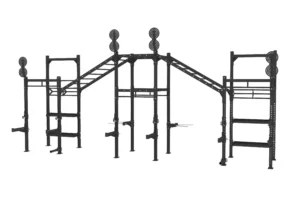
A squat rack is a four-post or two-post reinforced steel frame structure designed for Olympic barbell free-weight training. The core components include J-hooks for fixing barbells, adjustable safety spotter arms, bottom support frames and optional pull-up bars. Its working principle relies on gravity to generate free weight resistance, with completely free movement trajectories and no fixed track restrictions. Users can independently control movement speed, force angle and body balance, which highly restores the dynamic state of human muscle force in daily sports and strength exercises.
The structural design of the squat rack focuses on load-bearing stability and training safety. The thickened steel frame can bear super heavy barbell load, supporting unlimited progressive overload training by increasing weight plates. All training movements are based on human active control, which can fully activate body stabilizer muscles, improve overall coordination and core balance, and is the most effective equipment for building absolute strength and basic muscle mass. Its structural characteristics determine that it is more suitable for large-scale compound movements covering multiple muscle groups, rather than local fine shaping.
2.2 Cable Machine: Constant-Tension Fixed-Track Functional Training Device
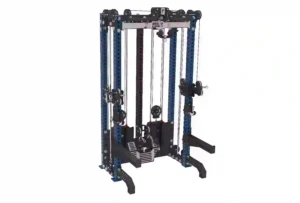
A cable machine is a professional functional training device composed of weight stacks, high-precision pulleys, high-tensile steel cables and adjustable tracks. It generates continuous resistance through cable traction, breaking the gravity resistance limitation of free weights. The core structural feature is multi-angle adjustable fixed track and constant tension output, which can provide stable and consistent muscle tension throughout the entire movement process without dead points.
Different from the free movement of squat racks, the cable machine’s movement track is guided by pulleys and cables, with standardized force direction and stable tension. It is divided into single-weight linked type and dual-weight independent type. The dual-weight cable machine can realize left and right asymmetric resistance adjustment, supporting precise unilateral muscle training and posture correction. Its structural advantages lie in flexible angle switching, diverse movement types and accurate muscle targeting, making up for the dead point and uneven tension defects of free weight training.
2.3 Intuitive Structural Parameter Contrast
In terms of space occupation, the squat rack has a larger vertical frame volume and needs to reserve barbell movement space on the front and rear sides, suitable for independent fixed training areas; the cable machine has a compact overall structure with flexible placement modes and lower space requirements. In terms of load-bearing upper limit, the squat rack’s weight can be increased infinitely with weight plates, suitable for extreme heavy-load training; the cable machine’s resistance is limited by the weight stack, with a fixed upper limit, unable to undertake super heavy strength training. In terms of failure rate, the squat rack has a pure mechanical frame structure with almost no vulnerable parts and extremely low maintenance cost; the cable machine has more transmission parts such as pulleys and cables, requiring regular inspection and lubrication maintenance.
3. Training Mechanism Differences: Resistance Curve & Muscle Activation Logic
The essential gap in training effect between squat racks and cable machines comes from different resistance curves and muscle activation mechanisms. Understanding the internal training principles can help users accurately match equipment with muscle training goals.
3.1 Squat Rack Free Weight Training: Variable Tension & Overall Strength Activation
Squat rack barbell training adopts gravity-dependent variable tension. During the movement process, the muscle tension is constantly changing with the angle, with obvious weak tension intervals and mechanical dead points. For example, in the barbell squat movement, the muscle tension is the smallest at the top standing position and the largest at the bottom squat position; in the flat bench press movement, the middle contraction stage has the strongest force, while the starting and ending stages have reduced tension. This variable tension mechanism conforms to the natural strength curve of human muscles and can effectively stimulate muscle growth and strength improvement.
Free weight compound movements represented by barbell squats, bench presses, overhead presses and deadlifts can activate multiple large muscle groups such as legs, chest, back and shoulders at the same time, and synchronously mobilize deep core stabilizer muscles to participate in force. This multi-muscle synergistic training mode can rapidly improve overall muscle mass, basic strength and bone density, and enhance human functional sports ability, which is irreplaceable for building a strong physical foundation.
3.2 Cable Machine Functional Training: Constant Tension & Precise Isolated Stimulation
The biggest core advantage of cable machines is full-range constant tension output. Different from free weight variable tension, the cable traction resistance remains stable throughout the entire stretching and contracting process of muscles, completely eliminating training dead points. This continuous tension greatly prolongs muscle time under tension (TUT), the core scientific indicator of muscle hypertrophy, and can significantly improve muscle shaping fineness and muscle separation.
The multi-angle adjustable pulley design of the cable machine can break the single vertical force limitation of gravity training, realize three-dimensional force in horizontal, inclined and vertical directions, and accurately target small and difficult-to-stimulate muscle groups such as rear deltoids, inner pectoral muscles, latissimus dorsi edges and abdominal oblique muscles. Its standardized movement track can avoid auxiliary muscle involvement, realize pure isolated training of target muscles, and effectively correct muscle imbalance and unbalanced physique problems caused by long-term free weight training.
3.3 Differences in Training Safety and Joint Protection
In terms of training safety, cable machines have natural advantages. The smooth and stable cable traction has no inertial swing impact force, which can buffer joint pressure, protect knee joints, shoulder joints and lumbar spine, and is suitable for beginner adaptive training, sports injury rehabilitation training and long-term high-frequency fine training. Even if the movement is slightly irregular, it will not cause excessive joint load and strain.
Squat rack free weight training has high requirements for movement standardization and core stability. Unstandardized posture and excessive load will easily cause instantaneous overload on the spine, knee joints and shoulder ligaments, leading to chronic sports injuries. However, its high stability and anti-fall safety structure can support near-limit heavy-load training, helping users break strength bottlenecks, which is the core advantage that cable machines do not have.
4. Functional Advantage Analysis: Exclusive Training Scenarios of Two Devices
Combined with structural and mechanical differences, squat racks and cable machines have their own exclusive high-efficiency training scenarios. Clarifying functional advantages is the core basis for equipment matching.
4.1 Exclusive Advantages and Core Training Items of Squat Racks
The core positioning of squat racks is heavy compound strength training and basic muscle mass building. Its exclusive advantages are reflected in unlimited progressive overload, multi-muscle synergistic activation and functional strength improvement. The core high-efficiency training items include barbell back squats, front squats, flat bench presses, incline bench presses, overhead presses, conventional deadlifts, Romanian deadlifts and pull-ups. These classic compound movements are the foundation of all strength training, which can efficiently improve overall strength, increase basic muscle mass, enhance body metabolism level, and lay a solid foundation for fat loss and muscle gain.
In addition, the squat rack can be matched with dumbbells, resistance bands and auxiliary training tools to expand diversified training modes, with extremely high training scalability. It is the only equipment suitable for long-term progressive strength breakthrough and professional bodybuilding basic training. For users whose core goal is to gain muscle mass, improve absolute strength and enhance physical fitness, the squat rack is indispensable core equipment.
4.2 Exclusive Advantages and Core Training Items of Cable Machines
The core positioning of cable machines is fine muscle shaping, posture correction and functional muscle training. Its exclusive advantages are full-range constant tension, multi-angle three-dimensional stimulation and unilateral precise correction. The core high-efficiency training items include cable chest flyes, face pulls, straight-arm pulldowns, tricep pushdowns, cable bicep curls, lateral raises, cable woodchoppers and unilateral corrective training.
These isolated and functional movements can polish muscle details, improve muscle fullness and separation, adjust left-right muscle strength balance, correct hunchback, shoulder asymmetry and unbalanced lower limb strength, and shape a symmetrical and three-dimensional fitness physique. At the same time, the low-joint-pressure training mode is suitable for low-threshold daily fitness, beginner entry training and post-injury rehabilitation training, making up for the shortcomings of single training fineness and high injury risk of squat rack training.
5. Inherent Limitations of Squat Racks and Cable Machines
Single equipment configuration has obvious functional limitations. Rational understanding of the shortcomings of the two devices can avoid over-reliance on single equipment and formulate scientific matching schemes.
5.1 Limitations of Squat Rack Training
First, insufficient fine muscle stimulation. Free weight compound training focuses on large muscle group development, and it is difficult to accurately target small muscle groups and muscle edges, resulting in insufficient physique fineness and easy formation of bulky but not three-dimensional muscle lines. Second, intermittent muscle tension has training dead points, resulting in insufficient muscle continuous contraction time and limited hypertrophy efficiency in local muscle areas. Third, high training threshold requires standardized posture and core control ability, which is easy to cause wrong force and injury for beginners. Fourth, it cannot correct muscle imbalance. Long-term bilateral synchronous free weight training will enlarge left-right muscle strength differences and aggravate physique asymmetry.
5.2 Limitations of Cable Machine Training
First, limited upper limit of absolute strength. Affected by the weight stack capacity, the cable machine cannot carry out super heavy load training, and it is difficult to break the overall strength bottleneck, unable to meet the basic strength growth needs of advanced trainers. Second, insufficient compound training efficiency. Single cable training cannot mobilize multiple large muscle groups for synergistic force, and the efficiency of building basic muscle mass is far lower than that of squat rack compound training. Third, insufficient stabilizer muscle activation. The fixed track guiding force makes the core and auxiliary muscle participation low, unable to improve overall functional strength and body coordination.
6. Accurate Equipment Matching Strategy Based on Fitness Goals & Crowds
Combined with the advantages and limitations of the two devices, we have sorted out targeted one-to-one equipment matching schemes for different fitness crowds, training goals and venue conditions, realizing zero-waste equipment configuration.
6.1 Choose Squat Rack Priority If You Have These Goals
Users whose core goals are rapid muscle mass gain, absolute strength improvement, basic physical fitness enhancement and professional bodybuilding foundation building must prioritize squat racks. This includes fitness beginners who need to lay a solid strength foundation, intermediate enthusiasts who break training bottlenecks, advanced trainers who pursue strength breakthroughs, and users with low body fat and thin body who need to gain muscle and shape a strong physique. For home gyms and studios focusing on heavy strength training and compound movement teaching, squat racks are the irreplaceable core equipment.
In terms of venue and budget adaptation, users with independent fixed fitness area, sufficient placement space and long-term fitness persistence plans are very suitable for configuring squat racks. Even with a limited budget, a single squat rack matched with a barbell and weight plates can complete 70% of core strength training, with extremely high basic cost performance.
6.2 Choose Cable Machine Priority If You Have These Goals
Users whose core goals are body shaping refinement, muscle imbalance correction, posture improvement, fat loss training and rehabilitation training should prioritize cable machines. This includes female fitness users pursuing compact muscle lines, users with asymmetric shoulders and back and poor posture, fitness beginners with weak core and unstandardized movements, and users recovering from sports injuries. Cable machines can achieve low-risk, high-precision muscle shaping and posture correction effects that free weight training cannot match.
For small apartment home gyms, micro studios with limited space, and users with limited initial budget who focus on daily fat loss and shaping, compact cable machines can meet full-body fine training needs with small space occupation and low investment, avoiding the space pressure and high threshold of squat rack training.
6.3 Dual Equipment Matching: The Most Scientific Configuration for Long-Term Fitness
For users who pursue comprehensive fitness effects, long-term systematic training and professional physique shaping, the combination of squat rack + cable machine is the ultimate scientific configuration. The squat rack undertakes heavy compound training to build basic muscle mass and absolute strength, solving the problem of insufficient overall muscle volume and strength; the cable machine undertakes fine isolated training and corrective training to polish muscle details, balance muscle strength and optimize body lines, making up for the fineness defects of free weight training.
The two equipment form a perfect complementary training system: heavy compound movements build the physique framework, and constant-tension isolated training enriches muscle details, realizing the dual improvement of muscle volume and fineness, strength and aesthetics. This dual matching scheme is the standard configuration of professional home gyms and high-end boutique studios, which can meet all training needs from beginner entry, intermediate muscle gain to advanced professional shaping.
7. Scientific Training Collocation Plan: How to Use Two Devices for Efficient Training
To maximize the value of equipment, we have sorted out a targeted collocated training routine for squat racks and cable machines, helping users avoid single training defects and achieve efficient muscle building and shaping.
7.1 Squat Rack Main + Cable Machine Auxiliary Routine (Suitable for Muscle Gain & Strength Improvement)
Take compound heavy training of squat rack as the main body and cable fine training as the supplement. The daily training logic is to complete heavy compound movements such as barbell squats, bench presses and deadlifts on the squat rack first to fully activate large muscle groups and break strength limits; then use the cable machine for isolated shaping and exhaustion training of target muscles. For chest training, complete heavy barbell bench presses first, then cable flyes to squeeze and shape chest muscles; for back training, complete barbell rows and pull-ups first, then cable face pulls and straight-arm pulldowns to polish back muscle lines; for shoulder training, complete barbell overhead presses first, then cable lateral raises and rear delt flyes to make up for insufficient small muscle stimulation.
7.2 Cable Machine Main + Squat Rack Auxiliary Routine (Suitable for Shaping & Posture Correction)
Take cable multi-angle fine training as the main body and squat rack light-load compound training as the supplement. It is suitable for fat loss shaping groups and posture correction groups. First, use cable machines for full-body isolated shaping training to activate target muscles and improve muscle tightness; then match light-load barbell compound movements on the squat rack to improve overall muscle coordination and avoid single muscle stiffness. This routine can effectively shape compact muscle lines, correct bad postures, and ensure the symmetry and aesthetics of the physique while losing fat.
8. Common Equipment Matching Misunderstandings to Avoid
In the process of equipment selection and collocation, most users fall into cognitive misunderstandings, resulting in low training efficiency and equipment waste. Summarizing common pitfalls can help users make rational configurations.
First, the substitution misunderstanding: thinking that squat racks can completely replace cable machines, resulting in rough muscle lines and unbalanced physique; or thinking that cable machines can replace squat racks, resulting in inability to gain muscle mass and weak basic strength. Second, the priority misunderstanding: blindly pursuing expensive dual equipment configuration in the early stage of fitness, resulting in idle equipment and waste of budget and space. Third, the single training misunderstanding: only using one equipment for long-term single training, leading to obvious training bottlenecks and slow progress. Fourth, the scenario mismatch misunderstanding: configuring heavy squat racks for small space studios focusing on shaping courses, or configuring single cable machines for strength training-oriented gyms, resulting in mismatched equipment and business needs.
9. Final Conclusion: Rational Collocation Creates a Perfect Training System
After comprehensive comparison of structural principles, training mechanisms, functional advantages and applicable scenarios, the core conclusion is clear: squat racks and cable machines are not competitive alternative equipment, but complementary core components of the strength training system. Squat racks are the foundation of strength training, responsible for building overall muscle mass and absolute functional strength; cable machines are the polishing tool of physique training, responsible for optimizing muscle details and correcting physical asymmetry.
For fitness beginners and budget-limited users, a single equipment can be selected according to core goals: choose a squat rack for muscle gain and strength improvement, and choose a cable machine for fat loss and shaping. For users pursuing long-term professional fitness effects, the dual combination of squat rack and cable machine is the most scientific and cost-effective configuration scheme, which can cover all training scenarios and realize comprehensive physical improvement.
The essence of equipment matching is to adapt to personal fitness goals, venue conditions and training stages. Only by abandoning blind stacking and single equipment dependence and realizing targeted collocation can we maximize equipment value, avoid training detours, and efficiently achieve fat loss, muscle gain, posture correction and strength improvement goals.
Adhering to the original intention of original innovation and quality manufacturing, we will keep forging ahead, continuously enhance the brand’s global core competitiveness, let more Chinese innovative fitness products go global, and continuously transmit the strong innovation power of Chinese fitness brands to the global market, helping the high-quality and sustainable development of the global fitness industry.