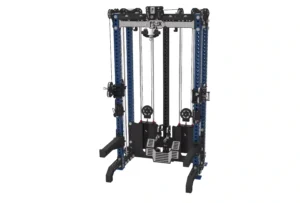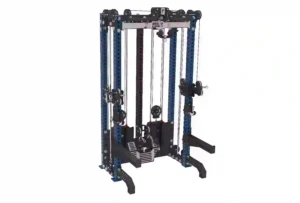
1. Introduction: Why a Wall-Mounted Power Rack Is a Full-Body Home Gym Solution
Building a functional home gym in a small apartment has long been a major challenge for urban fitness enthusiasts. Traditional free-standing power racks, multi-gym stations, and bulky strength equipment consume massive floor space, crowd living areas, and often force users to choose between fitness goals and comfortable living environments. This is where wall-mounted power racks have revolutionized modern home fitness. By combining a sturdy wall-fixed frame, foldable structure, and high-precision dual cable pulley systems, these compact racks deliver commercial-grade training performance without the permanent footprint of conventional gym gear.
Many beginners and intermediate lifters hold a common misconception: wall-mounted folding racks are only suitable for basic squats and pull-ups, with limited functional diversity for systematic full-body training. In reality, a fully equipped wall-mounted power rack supports over 100 compound and isolation movements covering the chest, back, shoulders, arms, core, glutes, and legs. Paired with standard cable accessories, barbell sets, and auxiliary attachments, it can completely replace a full-size commercial gym for daily muscle gain, fat loss, strength improvement, and physique shaping.
The biggest advantage of wall-mounted power rack training lies in its dual training mechanism: free-weight compound training for absolute strength and muscle mass growth, plus constant-tension cable training for fine muscle shaping and posture correction. Unlike fixed gym equipment with single training tracks, the adjustable pulley height, foldable frame design, and multi-angle force application of wall-mounted racks enable unrestricted movement trajectories, adapting to users of different heights, fitness levels, and training goals.
Whether you are a zero-based fitness beginner building a daily workout routine, an intermediate enthusiast pursuing symmetrical muscle development, or an advanced lifter maintaining professional training intensity at home, a wall-mounted power rack can match your training needs. This comprehensive guide will sort out a complete full-body workout list for wall-mounted power racks, classify compound and isolation movements by muscle group, elaborate on movement essentials, training benefits, rep and set schemes, and crowd adaptation, helping users maximize equipment utilization and achieve efficient full-body training in a limited space.
2. Core Training Advantages of Wall-Mounted Power Racks
Before diving into the detailed exercise list, it is essential to understand the unique training advantages of wall-mounted power racks that distinguish them from traditional floor racks and single-function cable machines. These advantages explain why this equipment can support comprehensive full-body fitness for all-level users.
2.1 Dual Free-Weight and Cable Training System
High-quality wall-mounted power racks integrate two core training modes in one compact frame. The main rack structure supports barbell free-weight training including squats, bench presses, deadlifts, and pull-ups, focusing on compound muscle group activation and absolute strength improvement. The matched dual cable pulley system provides full-range constant-tension training, making up for the dead-point defects of free-weight training and realizing precise isolated stimulation of small muscle groups. The dual-system combination perfectly balances muscle mass growth and detail shaping, which cannot be achieved by single-function fitness equipment.
2.2 Multi-Angle Adjustable Training Trajectory
The upper and lower adjustable pulley positions of wall-mounted cable racks support high, medium, and low three-dimensional force application angles, covering all classic cable movement trajectories in commercial gyms. High pulleys are suitable for downward pulling and pressing movements for back and arm training; medium pulleys fit flat pushing and pulling movements for chest and shoulder training; low pulleys adapt to hip, leg, and core pulling movements. The all-angle adjustment completely restores professional gym training logic, ensuring no missing muscle group stimulation.
2.3 Space-Free and High-Frequency Training Adaptability
Different from bulky floor-standing racks that occupy fixed space all year round, wall-mounted power racks can be folded and stored when not in use, restoring a spacious living environment. The low space threshold greatly reduces the psychological barrier of daily exercise, enabling users to achieve high-frequency fragmented training. Its stable wall-fixed structure also ensures higher training safety than ordinary floor racks, supporting single-person independent home training without a spotter.
2.4 Progressive Overload Scalability for Long-Term Fitness
The standard hole position design and expandable accessory interface of wall-mounted power racks support long-term progressive overload training. Users can gradually increase barbell load, replace high-load cable accessories, and expand functional attachments according to fitness progress, realizing seamless transition from beginner entry training to advanced professional bodybuilding training, with extremely long service life and high cost performance.
3. Upper Body Workout List: Chest, Back, Shoulder and Arm Training
The wall-mounted power rack covers almost all mainstream upper-body compound and isolation movements. By matching different handles and adjusting pulley heights, users can achieve targeted stimulation for every upper-body muscle group, solving the problems of single movement and insufficient muscle activation in small-space home training.
3.1 Chest Workouts: Compound Pressing and Isolated Squeezing Movements
Chest training with wall-mounted power racks combines heavy free-weight compound pressing and cable constant-tension squeezing, which can efficiently increase chest muscle thickness and improve chest muscle fullness and separation.
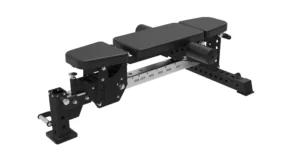
Barbell Flat Bench Press (Free-Weight Compound): This is the core movement for chest muscle mass growth. Unfold the wall-mounted rack, place the adjustable flat bench in front of the rack, adjust the J-hook height to fit the barbell position, and complete standard flat bench presses. This movement activates the entire pectoralis major, anterior deltoids, and triceps, greatly improving overall chest muscle thickness and upper body strength. It is suitable for all-level fitness users, with conventional training schemes of 4–5 sets of 8–12 reps for muscle gain, and 5 sets of 4–6 reps for strength improvement.
Cable Mid-Chest Flyes (Isolated Shaping): Adjust the dual pulleys to the medium horizontal position, match rotating D-handles, stand in the middle of the rack, keep the torso slightly forward, and complete horizontal chest squeezing movements. The constant cable tension eliminates training dead points, continuously stretches and squeezes the chest muscles, effectively polishing chest muscle edges, improving chest cleavage, and solving the problem of flat chest caused by single bench press training. It is recommended to do 3–4 sets of 12–15 reps for fine shaping.
Cable High-to-Low Chest Flyes: Adjust the pulleys to the high position, hold the D-handles with both hands, and pull down and inward obliquely. This movement targets the upper chest and inner chest muscles, improves upper chest fullness, and corrects the problem of sagging upper chest. It is an essential shaping movement for three-dimensional chest muscle development.
Cable Low-to-High Chest Flyes: Adjust the pulleys to the low position, pull up and inward, focusing on stimulating the lower chest muscle bundle, tightening the lower chest line, and avoiding loose lower chest muscles. Matched with mid-chest flyes, it realizes full-layer stimulation of the entire chest muscle.
3.2 Back Workouts: Width and Thickness Comprehensive Training
Wall-mounted power racks support vertical pulling and horizontal pulling movements, covering latissimus dorsi width training and rhomboid/erector spinae thickness training, helping users build a wide and thick inverted triangle back.
Barbell Pull-Ups (Compound Width Training): Use the top pull-up bar of the wall-mounted rack to complete standard pull-ups. This classic vertical pulling movement efficiently activates the latissimus dorsi, teres major, and upper back muscles, greatly increasing back width. Beginners can use resistance bands for assistance, while advanced users can add weight for progressive training.
Cable Straight-Arm Pulldowns (Isolated Lat Training): Adjust the high pulleys and match a straight bar handle, keep the arms straight, and pull down along the body line. This movement isolates the latissimus dorsi, avoids bicep substitution, and deeply stimulates the latissimus dorsi edge, improving back stretch and contraction sense. It is the best auxiliary movement for latissimus dorsi shaping.
Cable Seated Rowing (Back Thickness Training): Adjust the medium pulleys, sit on the ground, step on the front of the rack, hold the straight bar handle, and pull horizontally toward the lower abdomen. This movement targets the rhomboids, trapezius medius, and erector spinae, increases back thickness, improves hunchback posture, and enhances upper back stability.
Cable Face Pulls (Rear Deltoid and Upper Back Correction): Use high pulleys with tricep rope handles, pull the rope toward the forehead, and squeeze the rear shoulders and upper back. This movement effectively activates the inactive rear deltoids and upper back muscles, corrects rounded shoulders and hunchback, and improves upper body posture symmetry.
3.3 Shoulder Workouts: Three-Dimensional Deltoid Muscle Shaping
The deltoid muscle is divided into anterior, lateral, and posterior bundles, which require multi-angle isolated stimulation. The adjustable pulleys of wall-mounted racks can perfectly match all shoulder training trajectories to achieve comprehensive shoulder development.
Barbell Overhead Press (Compound Shoulder Strength): Place the barbell on the rack J-hooks, stand upright, and push the barbell vertically overhead. This compound movement activates the entire deltoid muscle group and triceps, improves shoulder overall strength and thickness, and shapes a straight shoulder line.
Cable Lateral Raises (Lateral Deltoid Shaping): Adjust medium pulleys, hold single D-handles with both hands, and lift horizontally to the side. This movement focuses on stimulating the lateral deltoids, widening the shoulder width, and creating a natural broad-shoulder effect, which is the core movement for shoulder three-dimensional sense.
Cable Front Raises (Anterior Deltoid Training): Use single-side low pulley traction, hold the handle and lift forward vertically, targeting the anterior deltoids to improve front shoulder fullness and coordinate upper body muscle proportion.
Cable Rear Delt Flyes (Posterior Deltoid Correction): Adjust high pulleys, lean forward, and pull the handles backward and outward to squeeze the rear deltoids. Most users have weak rear deltoid activation, and this movement can effectively make up for rear shoulder deficiencies and avoid front and rear shoulder imbalance.
3.4 Arm Workouts: Bicep and Tricep Fine Training
Arm muscles are small and require high-precision constant-tension stimulation. The cable system of wall-mounted racks can maintain continuous muscle tension, effectively promoting arm muscle hypertrophy and line refinement.
Cable Tricep Pushdowns (Tricep Main Training): Match high pulleys with tricep rope handles, clamp the upper arms close to the body, and push down the rope until the arms are fully straight. This movement isolates the triceps brachii, eliminates shoulder and back substitution, and efficiently shapes tight arm lines. Split rope design can stimulate the lateral and medial tricep bundles in all directions.
Cable Barbell Curls (Bicep Training): Adjust low pulleys with a straight bar handle, stand upright, and complete standard bicep curling movements. The constant cable tension avoids inertial force, keeps the biceps continuously contracted, and improves muscle peak sense and fullness.
Single-Arm Cable Hammer Curls: Use single-side D-handles for unilateral curling, balance left and right bicep strength differences, and improve arm symmetry, which is very suitable for users with asymmetric arm muscles.
4. Lower Body Workout List: Leg, Glute and Calf Training
Most small-space home gyms can only complete upper-body training, lacking professional lower-body training movements. However, wall-mounted power racks support heavy free-weight leg compound training and cable isolated glute and leg shaping training, realizing balanced full-body muscle development.
4.1 Core Leg Compound Movements
Barbell Back Squats (King of Lower Body Training): Adjust the rack J-hook and safety arm height, place the barbell on the upper back, and complete standard deep squats. This movement activates the quadriceps, glutes, hamstrings, and core muscles, improves lower body absolute strength, increases leg muscle thickness, and boosts basal metabolism. The safety arm design of the wall-mounted rack ensures safe single-person squat training, avoiding barbell falling risks.
Barbell Romanian Deadlifts: Hold the barbell with both hands, keep the legs slightly bent, and push the hips backward to stretch the hamstrings and glutes. This movement focuses on stimulating the posterior chain of the lower body, improving hamstring flexibility and glute muscle fullness, and solving the problem of weak posterior leg muscles.
4.2 Cable Isolated Glute and Leg Shaping Movements
Cable Glute Kickbacks: Match low pulleys with ankle straps, fix one foot on the strap, stand steadily, and kick backward to squeeze the glutes. This movement isolates the gluteus maximus, avoids leg muscle involvement, and efficiently lifts the hip line and shapes a perky hip shape.
Cable Lateral Leg Raises: Use low pulley ankle strap traction, stand sideways, and lift the leg outward to stimulate the gluteus medius and outer thigh muscles, improve hip width symmetry, and correct false hip width and thigh fat accumulation.
Cable Leg Curls: Adjust low pulleys, lie prone on the training bench, hook the ankle strap with the calf, and curl upward to target the hamstrings, balance the front and rear leg muscle proportion, and shape slender leg lines.
5. Core & Functional Training Workout List
Core strength is the foundation of all strength training. The multi-angle cable traction of wall-mounted power racks can complete diversified core functional training, improve core stability, abdominal muscle definition, and body coordination, which is far more comprehensive than traditional sit-up training.
Cable Woodchoppers (Oblique Abdominal Training): Adjust high and low pulleys alternately, hold the handle with both hands, and complete torso rotation and pulling movements. This movement efficiently stimulates the internal and external oblique abdominal muscles, shapes the waistline, reduces waist fat, and improves torso rotation strength and core flexibility.
Cable Crunches (Upper and Lower Abdominal Training): Fix the rope handle at the high pulley, kneel on the ground, and pull down with the abdomen to complete abdominal curling. The constant tension makes the abdominal muscles keep contracting, effectively improving abdominal muscle definition and avoiding lazy abdominal muscles caused by traditional sit-ups.
Cable Plank Pulls (Core Stability Training): Maintain a standard plank posture, hold the cable handle with one hand, and pull horizontally alternately. This movement activates deep core stabilizer muscles, improves overall core anti-torsion ability, and enhances body balance and coordination.
6. Full-Body Weekly Training Routine for Wall-Mounted Power Racks
To help users efficiently use wall-mounted power racks for systematic training, we have sorted out three sets of targeted weekly routines for different fitness levels, realizing scientific full-body muscle stimulation and progressive improvement.
6.1 Beginner Full-Body Routine (3 Days a Week)
Suitable for zero-based users, focusing on movement standardization and muscle perception training. Each training covers all major muscle groups with low load and high frequency. Core movements: barbell squat, barbell bench press, cable rowing, cable lateral raise, cable bicep curl, cable tricep pushdown, cable woodchopper. 3 sets of 12–15 reps for each movement, 60 seconds rest between sets, helping beginners build basic fitness habits and standard movement memory.
6.2 Intermediate Muscle Shaping Routine (4 Days a Week)
Adopt upper and lower body split training, focusing on balancing muscle development and polishing details. Day 1: Chest + Triceps; Day 2: Back + Biceps; Day 3: Shoulders + Core; Day 4: Legs + Glutes. Match compound movements with isolated shaping movements, 4 sets of 10–12 reps for compound movements, 3–4 sets of 12–15 reps for isolated movements, 45–60 seconds rest, realizing simultaneous muscle gain and shaping.
6.3 Advanced Strength & Hypertrophy Routine (5 Days a Week)
Adopt muscle group fine split training, add progressive overload training, and break muscle growth bottlenecks. Introduce high-load free-weight compound training and super-set cable shaping training to improve muscle thickness and separation. Appropriately increase training sets and reduce rest time to enhance training intensity, meeting professional bodybuilding training needs.
7. Training Tips to Maximize Wall-Mounted Rack Workout Effects
Although wall-mounted power racks have comprehensive training functions, improper use will lead to low training efficiency and even sports injuries. The following key tips can help users maximize equipment performance and training effects.
First, standardize pulley height adjustment. Different movements correspond to fixed pulley heights. Adjusting the pulley according to the muscle force angle can ensure targeted muscle stimulation and avoid auxiliary muscle substitution. Second, match exclusive accessories for different movements. Use straight bars for compound pulling and pressing, D-handles for unilateral shaping, and rope handles for arm and back fine training to improve training accuracy.
Third, combine free-weight and cable training reasonably. Prioritize heavy compound free-weight movements to break strength limits and increase muscle mass, then use cable constant-tension isolated movements to polish details, forming a scientific training closed loop. Fourth, make full use of safety protection structures. Always use safety arms and J-hooks during barbell training to ensure single-person training safety.
Fifth, adhere to progressive overload. Gradually increase barbell weight, cable resistance, training sets, or reduce rest time according to fitness progress to ensure continuous muscle stimulation and avoid training bottlenecks.
8. Conclusion: A Single Wall-Mounted Rack Equals a Complete Home Gym
To sum up, the wall-mounted power rack is not a single-functional auxiliary fitness equipment, but a comprehensive full-body training station covering upper body, lower body, core, strength, and shaping training. It breaks the space limitation of small-apartment home fitness, integrates the advantages of free-weight strength training and cable fine shaping training, and supports all-level users’ fitness needs from beginner entry to advanced professional bodybuilding.
From basic compound movements such as squats, bench presses, and pull-ups to high-precision isolated shaping movements for small muscle groups, every mainstream gym training action can be perfectly restored on a wall-mounted power rack. With reasonable accessory matching and scientific training routines, users can efficiently achieve fat loss, muscle gain, strength improvement, and posture correction at home, completely replacing expensive and crowded commercial gyms.
For modern urban fitness enthusiasts pursuing high-efficiency and space-saving home fitness, a wall-mounted power rack is the most cost-effective and functional comprehensive solution. It maximizes home space utilization, minimizes fitness thresholds, and maximizes training effects, helping every user build a professional private home gym and maintain long-term healthy fitness habits.
Adhering to the original intention of original innovation and quality manufacturing, we continuously optimize the structural design and functional scalability of wall-mounted fitness equipment, transmit the innovative strength of Chinese fitness brands to the global market, and provide global fitness users with high-quality, space-saving, and high-performance home gym solutions, boosting the sustainable development of the global home fitness industry.