1. Introduction: Equipment Dilemma Faced by Small Fitness Studio Gyms
Small private fitness studios, boutique training rooms, and micro gym spaces have become the fastest-growing segments in the modern fitness industry. Different from large-scale commercial chain gyms that pursue complete equipment clusters and large passenger flow, small studio gyms focus on personalized private training, customized fat loss and muscle gain plans, high-precision body shaping, and one-on-one professional guidance. Their core competitiveness lies in professional training services, private teaching quality, and high-space utilization, rather than stacking a large number of single-function fitness equipment. However, most small studio operators face a common operational dilemma: limited venue area, tight initial investment budget, and diverse customer training needs, making it impossible to purchase multiple sets of large-scale professional equipment like commercial gyms.
In the early stage of studio construction, many operators fall into two extreme configuration misunderstandings. Some blindly pursue complete equipment types, purchasing squat racks, cable machines, training benches, leg trainers, and rowing equipment separately, resulting in crowded venues, high equipment idle rates, excessive early investment pressure, and low capital turnover efficiency. Others excessively simplify equipment configuration, only equipped with dumbbells and simple auxiliary tools, leading to single training items, insufficient professional sense, inability to meet customers’ full-body strength training needs, and easy loss of high-quality customer groups.
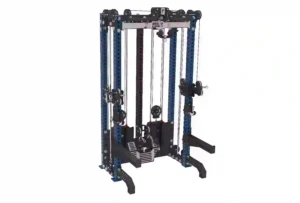
Against this background, the multi-functional power rack has gradually become the core preferred equipment for small studio gyms. Integrated with squat training, bench press training, pull-up training, cable functional training, and multi-angle auxiliary training, the all-in-one power rack breaks the functional boundary of traditional single-function squat racks. It can realize multi-muscle group and multi-mode training in a single station, which perfectly fits the small studio’s core demands of limited space, limited budget, and diverse training needs. But a key industry question remains controversial: can one single multi-functional power rack fully meet all equipment configuration needs of a small studio gym? Is one machine enough to support daily private teaching, group training, and member daily training? What are the functional shortcomings and configuration deficiencies of single power rack layout?
This in-depth professional blog will start from the operational characteristics, venue attributes, customer group needs and training scenarios of small studio gyms, comprehensively analyze the functional coverage advantages and inherent limitations of a single multi-functional power rack, sort out the applicable scenarios and insufficient scenarios of single-machine configuration, and summarize the most cost-effective minimal configuration and upgraded matching plan for small studios. It provides systematic equipment layout guidance for fitness studio operators, helping them balance venue space, investment cost, training comprehensiveness and operational efficiency.
2. Core Advantages of Single Multi-Functional Power Rack for Small Studio Configuration
The reason why multi-functional power racks are recognized as the core pillar of small studio gyms is that they integrate almost all mainstream strength training functions and solve multiple pain points of small venue operation. For micro studios with an area of 20 to 60 square meters, a single high-quality multi-functional power rack can replace 80% of traditional scattered strength equipment, with extremely high space utilization and cost performance.
2.1 All-In-One Functional Coverage to Meet Full-Body Strength Training
Different from ordinary ordinary squat racks that only support squat and pull-up movements, professional multi-functional power racks are equipped with expanded functional modules such as adjustable cable systems, multi-angle training bench matching ports, leg training accessories, and safety protection structures. A single device can cover full-body compound training and isolated fine training of chest, back, shoulders, arms, core, hips and legs. In terms of core compound training, it supports standard barbell squats, bench presses, overhead presses, deadlift auxiliary training, pull-ups and lat pulldowns, covering the basic compound movements necessary for muscle growth and strength improvement.
In terms of fine isolated training, the matching dual-cable system supports cable flyes, seated rows, face pulls, tricep pushdowns, bicep curls and core woodchoppers; the adjustable training bench matched with the rack realizes multi-angle chest and shoulder shaping; the reserved leg training module meets leg extension and leg curl training needs. For most individual fitness enthusiasts, weight loss groups, muscle shaping customers and basic strength improvement customers, the training functions covered by a single multi-functional power rack are completely sufficient, without any lack of training items.
2.2 Ultra-High Space Utilization, Perfectly Adapted to Small Venues
The biggest advantage of multi-functional power racks for small studios is integrated space optimization. Traditional gym equipment configuration requires independent placement space for squat racks, cable machines, training benches, leg trainers and rowing machines, which occupies a huge area and easily leads to messy venue layout and crowded training passages. The multi-functional integrated design integrates all functional modules into one frame, with centralized placement, standardized occupied area, and no redundant space waste. The conventional occupied area of a complete set of multi-functional power rack combination is only 3 to 4 square meters, which saves more than 60% of space compared with scattered single-function equipment.
For small studios with extremely limited space, this centralized configuration mode can reserve enough free activity area for group aerobics, functional physical training, stretching rehabilitation and private teaching guidance, making the venue layout more neat and professional, improving the overall high-end sense of the studio, and bringing a better training experience for members.
2.3 Low Initial Investment and High Long-Term Operational Cost Performance
Opening a small fitness studio faces high costs such as venue rent, decoration, labor and market promotion. Equipment investment needs to strictly control the budget and avoid capital pressure caused by excessive equipment stacking. A high-quality multi-functional power rack integrates the functions of multiple professional equipment, and the one-time procurement cost is far lower than the total price of purchasing separate squat racks, cable machines and auxiliary training equipment. It greatly reduces the initial equipment investment threshold for studio opening.
In terms of later operation and maintenance, the integrated power rack has a unified frame structure, fewer vulnerable parts, simple daily maintenance, and low failure rate. Compared with multiple scattered equipment requiring multi-party maintenance and inspection, it saves a lot of time cost and maintenance cost for studio operation. At the same time, the multi-functional power rack has strong training scalability, which can meet the progressive training needs of members from beginner adaptation, intermediate muscle hypertrophy to advanced strength breakthrough, avoiding frequent equipment replacement and upgrading in the later stage, and improving long-term operational cost performance.
2.4 Standardized Training Station, Suitable for Professional Private Teaching Guidance
Small studio gyms mainly rely on one-on-one private training and small-group training to profit, which puts forward high requirements for the standardization and professionalism of training equipment. The multi-functional power rack is designed according to commercial training standards, with stable frame structure, accurate adjustment gears, safe limit protection and standard movement track guidance. Professional coaches can formulate targeted fat loss, muscle gain, posture correction and strength training plans based on the rich functional movements of the power rack.
Whether it is beginner adaptive training, sports injury rehabilitation training, daily body shaping training or advanced strength breakthrough training, it can be completed on a single power rack station. The unified training station also helps coaches standardize teaching processes, improve teaching efficiency, and form a standardized private teaching system, which is conducive to studio brand building and member repurchase rate improvement.
3. Inherent Limitations of Single Power Rack Configuration in Small Studios
Although a single multi-functional power rack has outstanding configuration advantages, it cannot fully cover all operational scenarios of small studios. With the growth of studio member volume, the single-machine configuration will gradually expose functional and operational limitations, which are concentrated in training efficiency, crowd adaptation, project expansion and multi-person parallel training.
3.1 Insufficient Multi-Person Parallel Training Capacity, Restricting Customer Reception Volume
The biggest core limitation of single power rack configuration is single station attributes. One integrated power rack can only support 1 to 2 people to train at the same time. In the peak training period of evening and weekend holidays, when multiple members make appointments for training at the same time, equipment congestion and waiting will occur, resulting in prolonged member training time, reduced training experience, and even member churn caused by long waiting.
For small studios with less than 10 regular members, the single-station configuration can basically meet the demand; but when the number of regular members exceeds 15 to 20, the single equipment training bottleneck will be completely exposed, which seriously restricts the studio’s customer reception capacity and operational income growth, and cannot support the studio’s scale expansion.
3.2 Lack of Aerobic and Physical Training Equipment, Single Training System
The multi-functional power rack focuses on strength training and cannot cover aerobic fat burning, physical fitness improvement, flexibility training and rehabilitation stretching projects. Most studio members have dual needs of fat loss and shaping, not only needing strength training to increase muscle mass and shape lines, but also needing aerobic training to consume calories and reduce body fat. A single power rack only has strength training functions, without treadmill, spinning bike, rowing machine and other aerobic equipment, resulting in incomplete studio training systems.
For customers who mainly lose fat and improve physical fitness, the single strength training project is too single, unable to form a scientific combination training mode of “aerobic + strength + stretching”, which affects the professional comprehensiveness of studio courses and is not conducive to meeting the diversified fitness needs of different age groups and different goal groups.
3.3 Limited Extreme Heavy Load Training, Unable to Meet Professional Trainer Needs
Household and small studio-level multi-functional power racks are optimized for comprehensive functional training, and their maximum load-bearing and limit strength are limited compared with full commercial heavy racks. Although they can meet the training needs of 95% of ordinary fitness groups, they are insufficient for professional bodybuilding enthusiasts, strength sports trainers and advanced fitness enthusiasts who pursue extreme heavy load training.
The limit weight of barbell squat and bench press supported by single studio power rack is limited, and the cable tension upper limit is fixed, which cannot meet the progressive overload training needs of professional advanced groups. If the studio locates in high-end customer groups and professional fitness crowds, the single power rack configuration will have obvious professional shortcomings.
3.4 Single Training Scene, Insufficient Support for Diversified Group Courses
Modern small studios rely on rich group courses to increase member activity and customer stickiness, including functional training, HIIT high-intensity interval training, core shaping courses, hip and leg shaping courses and other popular group training projects. A single power rack can only support single-person private teaching training, and cannot adapt to multi-person simultaneous group course training. The single equipment scene limits the studio’s course development richness, making it difficult to carry out diversified group training businesses and expand profit channels.
4. Accurate Judgment: When Is a Single Multi-Functional Power Rack Sufficient?
Combined with the functional advantages and limitations of the equipment, we can accurately define the applicable scenarios of single power rack configuration. For small studios that meet the following operational attributes, one multi-functional power rack is completely sufficient and the most cost-effective configuration scheme.
4.1 Small Micro Studios with Limited Venue Area
For studios with a venue area of 20 to 40 square meters, narrow space and no redundant placement space for multiple equipment, a single integrated multi-functional power rack is the optimal configuration. It avoids the clutter and congestion caused by multiple equipment stacking, ensures the neat and high-end venue environment, and fully meets the basic strength training needs of members. It is the only feasible high-quality configuration scheme for ultra-small fitness spaces.
4.2 Newly Opened Studios with Small Member Base
In the initial stage of studio opening, the number of regular members is small, and the daily training flow is low. There is no need to purchase a large number of equipment for standby. A single multi-functional power rack can fully meet the daily training and private teaching needs of initial members, effectively reducing the initial investment pressure, avoiding equipment idle waste, and realizing lightweight operation. After the number of members increases steadily, the equipment can be gradually upgraded and supplemented, which is in line with the phased operation logic of studio development.
4.3 Studios Focusing on Private Teaching and Precision Shaping
If the studio’s core business is one-on-one private teaching, posture correction, fat loss and muscle gain precision shaping, and sports rehabilitation training, without focusing on large-scale group courses and mass aerobic training, a single power rack is completely sufficient. All private teaching customized strength training plans can be completed based on the multi-functional power rack, and the equipment functions fully match the core business needs, with no functional waste or deficiency.
4.4 Budget-Limited Lightweight Operation Studios
For studio operators pursuing lightweight operation, low risk and high return, single power rack configuration can minimize equipment investment, shorten the cost recovery cycle, and reduce operational risks. On the premise of ensuring basic training professionalism, it realizes low-cost opening and stable operation, which is very suitable for individual entrepreneurs and small team studio projects.
5. Necessary Supplementary Configuration: How to Perfect Single Power Rack Studio Layout
For small studios that take a single multi-functional power rack as the core equipment, only adding a small number of low-cost auxiliary equipment can make up for the functional shortcomings, realize a comprehensive training system, and greatly improve the studio’s professionalism and member experience without increasing too much space and cost pressure.
5.1 Basic Dumbbell Set and Dumbbell Rack
Matching a complete set of adjustable dumbbells or fixed-weight dumbbells and a simple dumbbell rack can make up for the lack of free weight training of the power rack. Dumbbells support unilateral fine training, auxiliary shaping and beginner adaptive training, forming a perfect complement to the power rack’s fixed track training. The occupied space is small and the cost is low, which can greatly enrich training movements.
5.2 Mini Aerobic Auxiliary Equipment
It is recommended to equip a single silent spinning bike or folding rowing machine, which occupies a small space and low investment. It can meet the basic aerobic fat loss needs of members, form a “strength + aerobic” scientific training mode, make up for the single training type of pure strength equipment, and improve the comprehensiveness of studio courses.
5.3 Core and Stretching Auxiliary Tools
Low-cost auxiliary tools such as yoga mats, resistance bands, foam shafts, balance balls and stretching racks can enrich core training, rehabilitation stretching and physical training projects, meet the warm-up and relaxation needs before and after training, improve the professionalism of teaching services, and bring more detailed training experience to members.
6. Upgrade Strategy: When to Add Equipment for Small Studio
With the steady development of the studio, when the following three situations occur, it means that the single power rack configuration has been unable to meet the operational needs, and equipment upgrading and expansion are required in a timely manner.
First, the number of regular members exceeds 20, and peak-time equipment waiting often occurs, resulting in member complaints and experience decline. At this time, a second multi-functional training station or independent cable machine can be added to improve parallel training capacity.
Second, the studio expands group course business, and needs to carry out multi-person simultaneous functional training and shaping courses. It is necessary to add multi-functional auxiliary training equipment and expand training stations to adapt to group course teaching.
Third, the studio upgrades its positioning to professional strength training and high-end private teaching, and needs to supplement heavy commercial power racks, professional aerobic equipment and rehabilitation equipment to improve the upper limit of professional training.
7. Final Verdict: Rational Definition of Single Power Rack Configuration Value
After comprehensive analysis of venue adaptation, functional coverage, operational demand and cost performance, the clear conclusion is: for 90% of newly opened, small-space, lightweight-operated boutique fitness studios, one qualified multi-functional power rack is sufficient as the core equipment configuration. It can fully meet the daily strength training, private teaching guidance and member shaping needs, with high space utilization, low investment risk and strong operational practicability.
However, a single power rack is not a panacea. It needs to be matched with a small number of low-cost auxiliary dumbbells, aerobic equipment and stretching tools to form a complete closed-loop training system. For studios with large member flow, diversified course needs and professional high-end positioning, it is necessary to carry out phased equipment upgrading and expansion on the basis of single core equipment.
The core of small studio equipment configuration is not superposition quantity, but matching demand. Blindly stacking equipment will lead to idle waste and increased operational pressure, while excessive simplification will lead to insufficient professionalism. Taking the multi-functional power rack as the core and matching auxiliary equipment according to actual operational needs is the most scientific, cost-effective and sustainable configuration scheme for small fitness studios.
Adhering to the original intention of original innovation and quality manufacturing, we will keep forging ahead, continuously enhance the brand’s global core competitiveness, let more Chinese innovative fitness products go global, and continuously transmit the strong innovation power of Chinese fitness brands to the global market, helping the high-quality and sustainable development of the global fitness industry.