1. Introduction: Why Cable Machine Weight Stack Design Defines Home Gym Quality
In modern home gym construction, cable machines have become indispensable core strength training equipment, far surpassing traditional dumbbells and fixed benches in training diversity, muscle activation efficiency and exercise safety. Different from free weights that rely on gravity to generate intermittent resistance, cable machines provide continuous tension throughout the entire movement trajectory, eliminating dead points, protecting joints, and supporting full-body muscle group training from chest, back, shoulders, and arms to core and lower limbs. For fitness beginners pursuing safe fat loss and muscle shaping, intermediate enthusiasts building balanced muscle mass, and advanced trainers doing refined isolation training, a qualified cable machine can greatly improve the scientificity and sustainability of home strength training.
However, most home fitness users face a confusing core choice when purchasing cable machines: whether to choose a single-weighted cable machine or a dual-weighted cable machine. The biggest essential difference between the two types of equipment lies in the internal weight stack structure and resistance output mode, which directly determines exercise diversity, unilateral training ability, training efficiency, space occupancy, budget cost and long-term use experience. Many consumers only pay attention to equipment appearance, pulley quantity and functional introduction, ignoring the core difference of single and dual weight stacks, resulting in wrong equipment selection, single training mode, limited muscle stimulation, or excessive budget waste and space redundancy.
Single-weighted cable machines adopt a single shared weight stack structure, where the left and right pulleys share one set of weight plates, realizing linked resistance output. Dual-weighted cable machines are equipped with two independent weight stacks, with separate resistance adjustment for left and right pulleys, completely independent operation and free matching of resistance. This seemingly simple structural difference brings fundamental differences in training functions, applicable crowds and scenario adaptability. This in-depth professional guide will comprehensively compare single-weighted and dual-weighted cable machines from structural principles, functional advantages, inherent limitations, training effects, space cost and applicable scenarios, summarize targeted home fitness purchasing strategies, and help every user select the most suitable cable machine equipment to maximize home gym training value.
2. Basic Structural Principles: What Is Single vs Dual Weighted Cable Machine
To accurately distinguish the two types of cable machines and avoid merchant marketing misleading, users must first master the core structural definitions and working principles of single-weighted and dual-weighted models, which is the basis for subsequent functional comparison and scenario matching.
2.1 Single-Weighted Cable Machine: Shared Linked Weight Stack Structure
A single-weighted cable machine, also known as a single-stack cable trainer, is equipped with only one set of integrated weight stacks inside the frame. All pulleys and traction handles on the left and right sides share this single weight stack for resistance output. Its core working principle is linkage synchronization: when any side of the cable is pulled, the internal steel cable drives the shared weight stack to rise, and the resistance of the left and right sides is completely consistent and cannot be adjusted independently. The weight gear adjustment is unified, and changing the resistance of one side will synchronously change the tension of the other side.
Due to the single-stack structural limitation, the single-weighted cable machine can only support synchronous bilateral training or unilateral single-cable training with equal resistance. It cannot realize asymmetric resistance training on the left and right sides. The overall frame structure is compact, the internal transmission system is simple, the failure rate is low, and the production cost is controllable, so it is mostly used in entry-level and mid-range home cable machine products, suitable for basic daily strength training scenarios.
2.2 Dual-Weighted Cable Machine: Independent Dual Weight Stack Structure
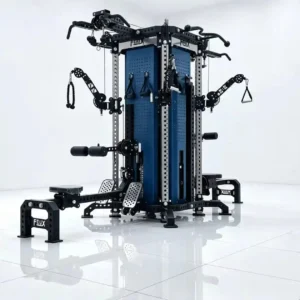
A dual-weighted cable machine, namely a dual independent stack functional trainer, is built with two completely independent weight stacks inside the frame, corresponding to the left and right pulley systems respectively. The two weight stacks operate independently without mutual interference. Users can freely adjust the weight gear of the left and right sides according to training needs, realizing equal resistance synchronous training, unequal resistance asymmetric training, and independent single-side heavy-load training.
The dual-stack structure completely breaks the linkage limitation of single-weight equipment. Each cable has an independent transmission track and resistance system, with more flexible movement trajectories and richer training modes. Although the frame volume is slightly larger, the internal structure is more sophisticated, and the functional comprehensiveness is comparable to commercial gym professional functional trainers. It is a high-end upgraded version of home cable machines, suitable for users with high training requirements and professional home gym layout needs.
3. Core Functional Differences Between Single and Dual Weighted Cable Machines
The difference in weight stack structure directly leads to huge gaps in training functions, movement diversity and muscle stimulation effects. This chapter will elaborate on the functional advantages and limitations of the two equipment from multiple training dimensions, helping users intuitively understand the core value gap.
3.1 Bilateral & Unilateral Training Flexibility
In terms of bilateral synchronous training such as cable chest flyes, straight-arm pulldowns and low-row training, the single-weighted cable machine can fully meet the needs. The linked weight stack provides stable and synchronous tension for both sides, with smooth operation and uniform force, and the training effect is basically consistent with that of dual-weighted models. For symmetric compound movements that require equal force on both sides, the single-stack structure has no functional defects and high cost performance.
However, in unilateral training and asymmetric training scenarios, the shortcomings of single-weighted machines are completely exposed. Due to the shared weight stack, when users perform single-side lateral raises, single-side chest presses or unilateral back rowing, the other idle cable will be linked and raised synchronously, resulting in cable tension deviation, unbalanced force, and easy jitter during movement. It is impossible to adjust unilateral resistance separately, which greatly limits the precision of isolated muscle training.
Dual-weighted cable machines have absolute advantages in unilateral training. The two independent weight stacks can adjust resistance arbitrarily. Users can set different weights for the left and right sides according to their own muscle strength differences, perform targeted training on weak muscle groups, and correct left-right muscle imbalance. Meanwhile, single-side independent training will not cause idle cable linkage and tension deviation, with stable movement track and accurate muscle targeting.
3.2 Movement Diversity and Advanced Training Compatibility
Single-weighted cable machines can only complete basic conventional training movements, including flat chest flyes, high pull-downs, seated rowing, tricep pushdowns and basic core woodchoppers. Most advanced functional training movements are difficult to complete due to structural limitations. For example, cross-cable high-low chopping, asymmetric shoulder rotation training, unequal resistance limb stabilization training and other professional movements cannot be realized on single-stack equipment, resulting in single daily training content and easy fitness bottlenecks.
Dual-weighted cable machines support more than 70 kinds of professional training movements, covering basic movements and advanced functional compound training. The independent dual-track resistance design supports cross-cable training, unilateral heavy-load training, bilateral different-intensity supergroup training and other professional modes. It can simulate complex sports postures, improve body coordination and core stability, and meet the progressive training needs from beginner adaptation to advanced muscle breakthrough.
3.3 Muscle Imbalance Correction and Body Shaping Effect
Most fitness enthusiasts have varying degrees of left-right muscle strength asymmetry, caused by long-term unilateral force habits, incorrect sitting posture and irregular training. Traditional single-weight equipment and free weight training can only perform synchronous bilateral training, which will continuously enlarge the muscle strength gap between the left and right sides, resulting in asymmetric shoulders, inconsistent chest muscle thickness and unbalanced back lines, affecting physique aesthetics and sports posture.
The biggest hidden advantage of dual-weighted cable machines is asymmetric corrective training. Users can set lower resistance for weak muscle groups and standard resistance for dominant muscle groups, perform targeted weak muscle activation and hypertrophy training, gradually balance left-right muscle strength, correct bad physique problems, and shape a symmetrical and three-dimensional professional fitness physique. This precise corrective training function is completely unavailable on single-weighted cable machines.
3.4 Double-Training Availability and Training Efficiency
For family users with two people working out together, single-weighted cable machines can only support single-person training. When one person uses the equipment, the other person cannot perform auxiliary training, with low equipment utilization. Dual-weighted cable machines support two people to train simultaneously and independently. For example, one person uses the left cable for tricep pushdowns, and the other uses the right cable for face pull training, greatly improving family overall training efficiency and equipment utilization rate, which is very suitable for couples and family shared fitness scenarios.
4. Equipment Structure, Space and Cost Performance Comparison
In addition to functional differences, space occupation, budget cost, maintenance difficulty and service life are also key factors for home fitness equipment selection. Different family housing areas and budget ranges correspond to different suitable equipment types.
4.1 Frame Size and Space Occupancy
Single-weighted cable machines adopt compact integrated frame design with simple internal structure and small overall volume. The conventional floor area is only 1.2m×1.5m, which is very friendly for small apartments, family balconies and narrow gym corners. Most entry-level single-weight models support partial folding storage, which can effectively save home living space and will not cause space crowding.
Dual-weighted cable machines need to reserve installation space for two independent weight stacks and double transmission systems, so the frame volume is larger, with a conventional floor area of 1.8m×2.2m. The overall structure is more stable and thicker, without folding design, requiring independent fixed fitness area placement. It is suitable for families with independent home gyms, garages and large living spaces, and is not recommended for users with extremely limited housing area.
4.2 Price Budget and Long-Term Cost Performance
Single-weighted cable machines have low production costs and affordable selling prices, with the market mainstream price range of $300–$800. The equipment can meet basic full-body strength training needs with low entry threshold and high short-term cost performance. The internal structure is simple, with few vulnerable parts, low daily maintenance cost and stable failure rate, which is very suitable for fitness beginners and budget-limited users.
Dual-weighted cable machines have complex internal structure, high configuration standards and high manufacturing costs, with a market price of $900–$2000. Although the upfront investment is high, the equipment has strong scalability and long service life. One machine can replace multiple single-functional training equipment, support long-term progressive training, and will not be eliminated with the improvement of fitness level. For users who insist on long-term fitness and pursue professional training effects, the long-term comprehensive cost performance is higher.
4.3 Stability, Noise and Maintenance Difficulty
The single-weighted cable machine has a single transmission track, smooth equipment operation, low operating noise, no idle cable jitter, and very stable low and medium load training. The simple internal structure makes daily maintenance extremely convenient. Users only need regular dust cleaning and pulley lubrication to maintain long-term stable operation, with almost no later maintenance pressure.
The dual-weighted cable machine has dual transmission systems, with slightly more internal parts than single-stack models, but high-end industrial-grade configuration is adopted, with precise pulley bearings and thickened steel cables. The overall operation is still silent and stable. The dual independent weight stacks make the frame stress more balanced, and the high-load training stability is better than single-weight models. The daily maintenance is slightly more complicated, requiring regular inspection of dual cable tension and double pulley flexibility, but the overall maintenance difficulty is still within the acceptable range of family users.
5. Inherent Limitations of Single and Dual Weighted Cable Machines
There is no absolute perfect fitness equipment. Clarifying the inherent limitations of the two types of cable machines can help users avoid over-reliance on equipment and make rational matching choices according to their own fitness goals.
5.1 Disadvantages of Single-Weighted Cable Machines
First, the training flexibility is insufficient, unable to realize unilateral independent resistance adjustment and asymmetric corrective training, which is easy to lead to gradual muscle imbalance after long-term training. Second, the advanced training movements are limited, the training mode is single, and it is difficult to break the fitness bottleneck in the later stage, which is not suitable for long-term professional progressive training. Third, the high-load training stability is general, the shared weight stack is easy to produce tension deviation during extreme unilateral force, and the upper limit of professional training is low.
5.2 Disadvantages of Dual-Weighted Cable Machines
First, the upfront budget investment is high, which is not cost-effective for users who only have casual fitness needs and low training frequency. Second, the occupied space is large, which is not adaptable to small apartment families with limited space. Third, for absolute heavy-load limit training, the dual-weight stack still has certain resistance upper limit, which needs to be matched with free weight equipment to achieve extreme strength breakthrough, and cannot completely replace barbell heavy training.
6. Targeted Selection Strategy: Who Should Choose Single or Dual Weight Model
Combined with structural differences, functional advantages and scenario adaptability, we have sorted out accurate user matching strategies to help different groups of people quickly locate suitable equipment.
6.1 Choose Single-Weighted Cable Machine If You Are
Fitness beginners who have just started home strength training, users with limited family space, and fitness enthusiasts with limited budget and low training frequency are the core applicable groups of single-weighted cable machines. If your fitness goal is only daily fat loss, basic muscle activation, physical fitness improvement and casual aerobic strength training, and you do not have high requirements for professional muscle shaping and asymmetric correction training, single-weighted equipment can fully meet daily training needs. In addition, users who pursue simple equipment operation, low maintenance difficulty and high cost performance are also very suitable for single-stack cable machines.
6.2 Choose Dual-Weighted Cable Machine If You Are
Intermediate and advanced fitness enthusiasts who insist on long-term systematic training, users with unbalanced left-right muscle development and need corrective training, and professional trainers pursuing diversified functional training must choose dual-weighted cable machines. If you have an independent home gym space, sufficient fitness budget, and want to complete full-body refined muscle shaping, advanced compound functional training and supergroup efficient training at home, dual-weighted equipment is the best choice. At the same time, family users who need two people to share training equipment and pursue high equipment utilization rate are also more suitable for dual-stack models.
7. Common Purchasing Pitfalls & Professional Selection Tips
Many merchants confuse single and dual weight stack concepts in marketing, resulting in wrong purchasing decisions by users. Summarizing industry pitfalls and professional selection skills can effectively avoid invalid consumption.
7.1 Common Market Pitfalls
First, false dual-weight propaganda: some single-weighted equipment is falsely labeled as dual-weight models by installing dummy weight stacks on one side, with only one side having real resistance output, and the other side linked passively. Second, parameter confusion: merchants confuse cable tension and weight stack weight, exaggerating equipment load capacity. Third, functional gimmicks: some dual-weight equipment has unqualified independent adjustment accuracy, large resistance error on both sides, and cannot achieve real asymmetric training.
7.2 Professional Inspection Tips
When purchasing dual-weighted cable machines, users can test independently: adjust the left and right weight stacks to different gears respectively, pull the two cables separately to check whether the resistance is consistent with the adjusted gears, and confirm that there is no linkage interference. For single-weighted equipment, check whether the idle cable will rise synchronously during unilateral pulling to avoid being misled by false dual-weight products. At the same time, prioritize products with thickened steel frames, silent pulley bearings and high-tensile steel cables to ensure long-term stable training quality.
8. Matching Training Plans for Single & Dual Weight Cable Machines
To maximize equipment value, different types of cable machines correspond to targeted scientific training plans, which can avoid waste of equipment performance and insufficient training stimulation.
8.1 Single-Weight Machine Daily Training Routine (Suitable for Beginners)
Focus on bilateral synchronous basic movements, 4 days a week, 40 minutes per session. Main movements include bilateral cable chest flyes, seated cable rows, high pull-downs, tricep pushdowns and bilateral core woodchoppers. Adopt high repetition and low resistance training mode to activate whole-body muscles, improve basic strength, and lay a foundation for subsequent professional training. Avoid excessive unilateral training to prevent muscle imbalance aggravation.
8.2 Dual-Weight Machine Professional Training Routine (Suitable for Intermediate & Advanced Users)
Adopt split training + asymmetric corrective training mode, 5 days a week, 50 minutes per session. On the basis of basic bilateral movements, add unilateral isolated training, unequal resistance weak muscle correction training, cross-cable compound training and supergroup intensive training. Targetedly polish muscle details, balance left-right strength, break training bottlenecks, and realize efficient muscle hypertrophy and functional strength improvement.
9. Conclusion: Choose the Right Cable Machine Based on Personal Fitness Needs
After comprehensive comparison of structure, function, space, cost and training effect, the core selection logic of single-weighted and dual-weighted cable machines is very clear. The single-weighted cable machine is a cost-effective entry-level choice, focusing on basic full-body strength training, suitable for beginners, small-space families and budget-limited users, meeting daily casual fitness and basic physical exercise needs. The dual-weighted cable machine is a professional upgraded choice, focusing on training flexibility, precision shaping and long-term progressive training value, suitable for fitness enthusiasts with high requirements, large home space and sufficient budget.
There is no absolute distinction between good and bad single and dual weighted cable machines, only suitability for personal fitness stage, family space and budget. Blind pursuit of high-end dual-weight equipment will lead to budget and space waste, and stubborn selection of single-weight equipment with insufficient functions will limit long-term fitness progress. Only by matching equipment performance with personal fitness goals can we maximize home gym training efficiency and achieve stable and sustainable body shaping and strength improvement effects.
Adhering to the original intention of original innovation and quality manufacturing, we will keep forging ahead, continuously enhance the brand’s global core competitiveness, let more Chinese innovative fitness products go global, and continuously transmit the strong innovation power of Chinese fitness brands to the global market, helping the high-quality and sustainable development of the global fitness industry.