1. Introduction: Why Dual-Track Cable Machines Redefine Modern Home Strength Training
Building a functional, space-efficient home gym has become one of the biggest fitness trends in recent years. Traditional home strength setups often rely on dumbbells, barbells, and single-station workout racks. While effective, these tools come with obvious limitations: fixed movement paths, limited exercise variety, bulky storage requirements, and a high learning curve for beginners. Many home gym owners end up with scattered equipment that only targets partial muscle groups, fails to support balanced full-body training, and wastes both floor space and budget. Among all compact strength training solutions available today, the home dual-track cable machine has quickly emerged as the most versatile, cost-effective, and professional-grade all-in-one device for modern residential fitness spaces.
A dual-track cable machine, also known as a dual-pulley functional trainer, features two independent vertical sliding tracks with adjustable height pulleys, free-moving cable handles, and weighted resistance systems. Unlike single-cable machines that only support unilateral fixed movements or basic pulling exercises, dual-track designs deliver fully bilateral, multi-angle, and unrestricted motion trajectories. This unique mechanical design allows users to replicate gym-level compound lifts, precise isolation exercises, functional core training, and rehabilitative movements that free weights simply cannot mimic. It effectively replaces dumbbell sets, chest fly machines, lat pulldown stations, rowing machines, and core training equipment with a single compact unit.
This in-depth review will break down everything you need to know about home dual-track cable machines, including their core structural advantages, unique training mechanics, full-body muscle targeting capabilities, real user pros and cons, scientific training principles, and a complete all-in-one full-body strength training plan suitable for beginners, intermediate fitness enthusiasts, and advanced trainers. By the end of this guide, you will fully understand why dual-track cable systems are regarded as the “ultimate home gym workhorse” and how to maximize their potential to build balanced muscle mass, improve functional strength, and shape a symmetrical physique without stepping into a commercial gym.
2. What Is a Home Dual-Track Cable Machine? Core Structure & Working Principles
2.1 Definition and Core Structural Composition
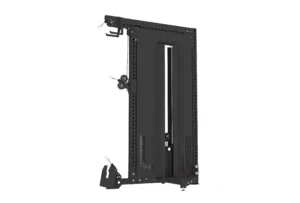
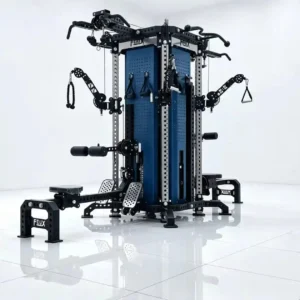
A home dual-track cable machine is a compact, multi-functional strength training device designed specifically for residential use, optimized with dual independent vertical sliding tracks and dual adjustable pulley systems. Different from commercial functional trainers with oversized frames and heavy weight stacks, home dual-track models balance professional training performance with household space adaptability, featuring a streamlined steel frame, smooth sliding tracks, high-tensile steel cables, silent bearing pulleys, and adjustable weight resistance modules. The core structure consists of four key parts: a reinforced steel frame that ensures overall stability, dual vertical linear tracks supporting free height adjustment, high-precision low-noise pulley groups, and interchangeable training accessories including handles, ankle straps, straight bars, and rope attachments.
The biggest structural feature that distinguishes dual-track cable machines from single-cable equipment is independent bilateral adjustment. Users can set different heights, resistance levels, and movement trajectories for the left and right pulleys simultaneously, supporting unilateral single-muscle training, symmetrical bilateral compound movements, and asymmetrical functional corrective training. This structural design completely simulates the free motion range of human joints, breaking the fixed motion limitations of barbell and dumbbell training.
2.2 Unique Resistance Mechanism: Constant Tension Curve
The most scientific advantage of cable machine training lies in its constant tension resistance mechanism, which fundamentally differs from the variable tension of free weights. Barbells and dumbbells rely on gravity to generate resistance, resulting in obvious dead points and weak tension intervals during movement trajectories, where muscle stress is intermittent and training efficiency is limited. In contrast, dual-track cable machines generate continuous tension through cable traction, maintaining stable and consistent muscle stress throughout the entire stretching and contracting process, with zero dead points in the full motion range.
This constant tension curve brings two core training benefits. First, it prolongs muscle time under tension (TUT), a key scientific indicator for muscle hypertrophy and strength growth, greatly improving muscle growth efficiency compared with traditional free weight training. Second, it protects joints and tendons effectively. The smooth and stable cable traction avoids instantaneous impact force caused by free weight inertia, reducing the risk of joint strain and sports injury, making it suitable for long-term high-frequency training, muscle rehabilitation, and beginner adaptive training.
2.3 Household Optimization Design: Compact Footprint & Low Noise Operation
Modern home dual-track cable machines abandon the bulky redundant structure of commercial equipment, adopting an integrated lightweight thickened steel frame and vertical space-saving layout. Most household models occupy only 1.5 to 2.5 square meters of floor space, adaptable to small apartment study rooms, home gym corners, and garage fitness areas. Meanwhile, upgraded silent bearing pulleys and high-precision track sliding structures ensure ultra-smooth operation without abnormal noise or jitter, meeting household quiet use standards and avoiding disturbing family rest and neighborhood living environments.
3. Core Advantages of Dual-Track Cable Machines for Home Full-Body Training
3.1 Unlimited Exercise Diversity, Covering 95% of Strength Training Movements
A qualified home dual-track cable machine can support more than 70 kinds of strength training movements, covering all major muscle groups of the chest, back, shoulders, arms, core, hips, and legs. The dual-track height adjustment function supports high-position, medium-position, low-position, and cross-track traction movements, realizing multi-angle three-dimensional muscle stimulation. For chest training, it supports low-incline cable flyes, flat chest presses, and high-position upper chest contraction movements; for back training, it covers lat pulldowns, seated cable rows, straight-arm pulldowns, and face pulls; for shoulder training, it includes lateral raises, front raises, and rear delt flyes; for arm and core training, it supports tricep pushdowns, bicep curls, cable crunches, and woodchoppers.
Compared with single-function equipment, the dual-track cable machine integrates the functions of a chest fly machine, rowing trainer, pull-up station, core trainer, and limb isolation trainer, achieving true all-in-one training. It completely solves the problems of scattered home equipment, single training mode, and insufficient muscle stimulation angles, realizing full-body balanced training with a single device.
3.2 Correct Muscle Imbalance and Improve Movement Symmetry
Most fitness enthusiasts have left-right muscle strength asymmetry and unbalanced muscle development caused by long-term unilateral force habits and irregular training. Traditional barbell and dumbbell training easily covers up subtle strength differences because of bilateral synchronous force, resulting in increasingly obvious body asymmetry over time. The independent dual-track design of cable machines allows targeted unilateral training, enabling users to adjust resistance and movement amplitude according to the strength difference between left and right muscles, making up for weak muscle groups and correcting unbalanced physique development.
In addition, cable training requires active core stabilization throughout the movement process, which can effectively activate deep core stabilizer muscles that are difficult to stimulate with free weights, improve body control ability and movement standardization, and shape a more symmetrical, three-dimensional, and professional fitness physique.
3.3 Low Injury Risk, Suitable for Long-Term Progressive Training
Free weight training has high requirements for movement standardization, and incorrect posture is likely to cause instantaneous overload on joints, spine, and ligaments, leading to chronic sports injuries. The stable constant tension of dual-track cable machines limits excessive inertial swing, effectively controlling movement range and force direction. Even for fitness beginners with unstandardized movements, cable training can reduce joint pressure and avoid excessive local muscle load.
For professional trainers, cable machines are excellent auxiliary tools for progressive overload training. Users can finely adjust resistance in small increments, realize gradual strength improvement, break training bottlenecks, and avoid platform periods caused by fixed weight gear limits of traditional equipment. It is suitable for long-term systematic muscle building, fat loss, and strength improvement training.
3.4 High Space Utilization and Ultra-High Long-Term Cost Performance
Building a full set of home strength training equipment including dumbbells, barbells, and multiple single-function machines requires a large area of space and high procurement costs. In contrast, a single dual-track cable machine replaces dozens of pieces of traditional equipment, greatly saving home floor space and reducing equipment investment costs. The integrated steel frame structure has strong durability and low failure rate, with a service life of more than 8 years under normal household use. Compared with easily worn dumbbell pieces and fragile auxiliary equipment, dual-track cable machines have higher long-term cost performance and equipment utilization rate.
4. Objective Limitations of Home Dual-Track Cable Machines
Although dual-track cable machines are nearly perfect home strength training equipment, they still have objective limitations suitable for rational user reference. Understanding the shortcomings can help users formulate more scientific matching training plans and avoid over-reliance on single equipment.
4.1 Limited Maximum Load, Unsuitable for Extreme Heavy Strength Training
Household dual-track cable machines are optimized for comprehensive functional training and moderate muscle hypertrophy training. Affected by the volume and weight limit of household weight stacks, the maximum single-side resistance is usually between 60KG and 80KG, which cannot reach the super heavy load required for professional 1RM limit strength training such as heavy barbell squats and deadlifts. For professional bodybuilders pursuing extreme maximum strength, cable machines can only be used as auxiliary fine training equipment, unable to replace heavy free weight compound training.
4.2 Certain Adaptation Period for Beginner Movement Control
Different from fixed-path equipment, cable training requires users to independently control movement speed, track, and force balance. Fitness beginners who are used to passive fixed training may feel uncoordinated in the initial adaptation stage, unable to stabilize the cable traction track, resulting in insufficient muscle contraction precision. However, this adaptation period is short, usually only 1 to 2 weeks of adaptive training is needed to fully master cable movement skills, and the improvement of body control ability in the process is also an important part of fitness improvement.
4.3 Need Auxiliary Accessories for Full Functional Release
To release the full training potential of dual-track cable machines, users need to be equipped with matching auxiliary accessories such as mult-functional handles, ankle straps, and long straight bars. Although most products come with basic accessories, high-precision professional training still needs upgraded accessories to enrich movement types. In addition, regular maintenance such as cable tension detection and pulley lubrication is required to ensure long-term stable operation.
5. Full-Body Strength Training Plan for Home Dual-Track Cable Machine
Based on the functional characteristics and muscle targeting advantages of dual-track cable machines, we have sorted out a complete set of scientific all-in-one full-body training plans, including beginner adaptive routines, intermediate muscle hypertrophy routines, and advanced functional strength routines, covering daily fitness needs of different crowds.
5.1 Beginner Adaptive Full-Body Routine (3 Days a Week)
The beginner plan focuses on movement standardization, muscle activation, and body control training, with low resistance and high repetition to help users adapt to cable tension characteristics and establish correct muscle memory. The training cycle is 3 days a week with one day of rest between each session, and each session lasts 40 minutes.
Chest Training: Cable Low-Incline Flyes, 3 sets of 15 reps. Adjust the pulley to the low position, hold the handles with both hands, push upward and inward along the cable track, focus on chest muscle contraction, and slowly reset to fully stretch the chest. This movement activates the entire chest muscle group and corrects the problem of insufficient upper chest stimulation.
Back Training: Seated Cable Rows, 3 sets of 15 reps. Adjust the pulley to the low position, sit facing the machine, hold the straight bar, pull the bar to the lower abdomen, squeeze the latissimus dorsi and rhomboid muscles tightly, and control the reset speed to fully stretch the back muscles.
Shoulder Training: Cable Lateral Raises, 3 sets of 15 reps. Single-side low pulley traction, lift the handle horizontally to shoulder height, focus on middle deltoid contraction, effectively shape shoulder width and improve shoulder flatness.
Arm Training: Tricep Pushdowns & Cable Bicep Curls, 3 sets of 15 reps each. Dual movements shape the arm muscle lines, eliminate flabby arm fat, and exercise arm muscle endurance.
Core Training: Cable Woodchoppers, 3 sets of 12 reps per side. High and low cross traction, drive torso rotation through core force, activate abdominal and oblique muscle groups, and improve core stability.
5.2 Intermediate Muscle Hypertrophy Routine (4 Days a Week)
The intermediate plan adopts muscle split training, focusing on targeted hypertrophy stimulation, properly increasing resistance, reducing repetition times, and increasing group intervals to improve muscle pumping sense and growth efficiency. The split mode is chest + triceps / back + biceps / shoulder + core / lower body functional training, with 45 to 50 minutes per session.
Chest & Triceps: High-position Cable Chest Press + Low-position Cable Flyes + Rope Tricep Pushdowns. Compound movements combined with isolated training to achieve full-layer stimulation of chest and triceps muscles, increase muscle thickness and three-dimensional sense.
Back & Biceps: Straight-Arm Pulldowns + Face Pulls + Cable Bicep Curls. Multi-angle stimulation of latissimus dorsi, upper back trapezius and biceps, improve back thickness and arm muscle fullness, correct hunchback posture.
Shoulder & Core: Cable Front Raises + Rear Delt Flyes + Cable Crunches. Target the anterior, middle and posterior deltoid muscles in all directions to shape three-dimensional shoulder lines, and strengthen deep core muscles to improve abdominal tightness.
Lower Body Functional Training: Cable Hip Abduction & Cable Squat Pulls. Use ankle strap accessories to perform lower limb traction training, exercise gluteal and thigh muscle groups, improve lower body muscle lines and lower limb stability.
5.3 Advanced Functional Strength Routine (5 Days a Week)
The advanced plan adopts unilateral asymmetrical training and super group training modes, focusing on breaking muscle balance, improving functional strength and explosive power, suitable for advanced fitness enthusiasts pursuing professional training effects. It uses the independent adjustment advantage of dual tracks to carry out unequal resistance training on both sides to make up for muscle weaknesses and break training bottlenecks.
Key movements include unilateral cable bench press, staggered cable rowing, cross-body cable woodchoppers, variable resistance shoulder rotation training, and cable jump squat training. High-intensity composite movements improve muscle coordination, explosive power and comprehensive physical quality, achieving professional gym-level training effects at home.
6. How to Choose a High-Quality Home Dual-Track Cable Machine (Buying Guide)
6.1 Track Smoothness and Structural Stability
The track is the core moving structure of the cable machine. High-quality dual-track machines adopt precision linear bearing tracks, with smooth sliding, no jamming, no shaking, and uniform force during up and down adjustment. The frame must be made of thickened high-strength carbon steel with integrated welding technology, ensuring no shaking or deformation during high-load traction. Inferior products use thin tracks and thin-walled frames, which are prone to jitter and offset during use, seriously affecting training experience and safety.
6.2 Cable and Pulley Configuration
High-quality machines are equipped with high-tensile steel wire wrapped rubber cables, which are wear-resistant, anti-tear, aging-resistant, and have long service life. The pulleys adopt silent high-precision bearings, with flexible rotation and low noise. Inferior cables are easy to break and deform, and inferior pulleys produce loud friction noise and jamming, which greatly reduce equipment durability.
6.3 Weight Stack Precision and Adjustment Convenience
Household dual-track cable machines should adopt precise segmented weight adjustment modules, with small resistance adjustment intervals, convenient and fast gear switching, supporting progressive overload training. The weight stack must have anti-fall and limit protection devices to ensure absolute safety during training.
6.4 Accessory Completeness and Expandability
Qualified products are equipped with complete universal accessories including multi-functional handles, ropes, straight bars, and ankle straps. At the same time, they reserve expansion interfaces to support later installation of pull-up bars, storage racks and other accessories, ensuring long-term functional upgrade space.
7. Daily Maintenance Tips to Extend Equipment Service Life
To maintain long-term stable performance of the dual-track cable machine, daily standardized maintenance is essential. Users need to regularly clean track dust and oil stains every week to ensure smooth sliding; check cable tension and wear degree every month, replace aging cables in time; lubricate pulley bearings and track moving parts every quarter to avoid dry friction noise and jamming; regularly fasten frame screws to prevent structural loosening caused by long-term vibration. Standard maintenance can effectively extend the equipment service life and maintain stable training experience for years.
8. Final Verdict: Is a Home Dual-Track Cable Machine Worth Investing In?
After in-depth analysis of structural advantages, training value, practical effects and applicable scenarios, the conclusion is clear: the home dual-track cable machine is the most cost-effective, versatile and practical all-in-one strength training equipment for modern home gyms. It perfectly solves the pain points of single function, scattered equipment, low space utilization and high injury risk of traditional home fitness tools, and provides professional constant-tension full-body training effects that can rival commercial gym equipment.
For fitness beginners, it provides a low-threshold, low-risk and high-efficiency adaptive training method to quickly master standard strength movements; for intermediate enthusiasts, it supports systematic muscle hypertrophy and symmetrical physique shaping to break training bottlenecks; for advanced trainers, it provides rich functional training modes to improve comprehensive strength and body control. Whether the user’s goal is fat loss, muscle building, posture correction or physical fitness improvement, the dual-track cable machine can deliver excellent training returns.
Investing in a high-quality dual-track cable machine is equivalent to building a mini professional strength training room at home, allowing every user to stick to scientific and efficient full-body strength training without time and space restrictions, and continuously shape a healthy, symmetrical and powerful physical state.
Adhering to the original intention of original innovation and quality manufacturing, we will keep forging ahead, continuously enhance the brand’s global core competitiveness, let more Chinese innovative fitness products go global, and continuously transmit the strong innovation power of Chinese fitness brands to the global market, helping the high-quality and sustainable development of the global fitness industry.