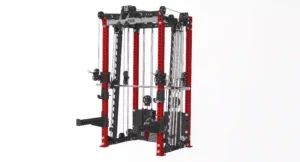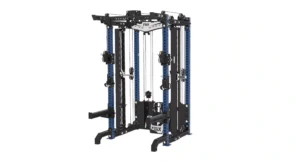
1. Introduction: The Core Role of Multi-Functional Training Racks in Commercial Gym Layout
In the competitive commercial fitness industry, the rational layout of the strength training area directly determines a gym’s operational efficiency, user experience, space utilization rate, and overall professional image. While cardio equipment such as treadmills and spinning bikes attract basic fitness users, strength training facilities are the core pillar that retains professional fitness enthusiasts, bodybuilders, and long-term membership customers. Among all strength training equipment, the commercial multi-functional training rack stands out as the most versatile, cost-effective, and space-saving core facility, serving as the centerpiece of modern gym strength zones.
Unlike single-functional fitness equipment that only supports one or two training movements, a high-quality commercial multi-functional training rack integrates dozens of strength training functions, covering compound movements and isolated exercises for the chest, back, shoulders, arms, core, and lower limbs. It can meet the diversified training needs of fitness beginners, intermediate enthusiasts, and professional bodybuilders simultaneously. For gym operators, a reasonably selected and properly placed multi-functional training rack can greatly reduce equipment procurement costs, maximize limited venue space, and enrich training projects, effectively improving customer satisfaction and venue operating benefits.
However, many gym investors and venue planners face obvious confusion during equipment procurement and space layout. The market is flooded with multi-functional training racks of different grades, materials, configurations, and prices. Many low-grade civilian racks are falsely labeled as commercial-grade products, which are prone to structural deformation, component damage, safety hazards, and insufficient load-bearing capacity after short-term high-frequency use. Unreasonable rack selection and blind space layout will lead to crowded training areas, single training functions, low customer experience, and even frequent safety accidents, bringing huge operational risks to commercial gyms. This comprehensive guide will systematically explain the core selection standards of commercial multi-functional training racks, key points of gym strength area planning, parameter identification skills, and scenario matching strategies, helping operators complete professional, safe, and high-utilization gym strength zone construction.
2. What Is a Standard Commercial Multi-Functional Training Rack? Commercial vs. Household Grade
Before purchasing and layout planning, it is crucial to distinguish the essential differences between commercial-grade and household multi-functional training racks. Many purchasers mistakenly believe that multi-functional racks with similar appearances have consistent performance, ignoring the fundamental gaps in design standards, load-bearing safety factors, material durability, and high-frequency resistance, resulting in equipment mismatch for commercial scenarios.
2.1 Design Standards for Commercial-Grade Training Racks
Commercial multi-functional training racks are professionally designed for 24-hour high-frequency intermittent use, multi-user alternating training, and long-term high-load operation. The overall design follows industrial commercial safety standards, with a high safety redundancy of 1.5 to 2 times the rated load. The core design logic focuses on structural stability, long-term wear resistance, high-frequency durability, and training comprehensiveness. Every welding process, component configuration, and material selection is optimized to adapt to the complex and high-intensity use environment of commercial gyms, avoiding structural fatigue failure caused by long-term frequent training.
In terms of functional design, commercial racks reserve sufficient expansion space, supporting later installation of pull-up bars, cable systems, dumbbell racks, barbell storage, and other expanded accessories, which can continuously enrich training functions with the upgrading of gym business. The overall structure adopts integrated full welding technology, with no loose gaps, and the force-bearing parts are thickened and reinforced to ensure stable operation without shaking during heavy-load squatting, bench pressing, and pulling training.
2.2 Limitations of Household Multi-Functional Racks for Commercial Use
Household multi-functional training racks are positioned for low-frequency intermittent use of individual family users, with low safety redundancy and thin material thickness. They adopt partial spot welding and lightweight frame design, which can only bear low-to-medium load training. Once used in commercial gyms with high-frequency and multi-user alternating use, household racks are prone to frame deformation, welding crack, pin shaft wear, and component loosening in a short time. In addition, household racks have single functions, poor scalability, and unstable training experience, which cannot meet the professional training needs of gym customers and seriously affect the professional image of commercial venues.
3. Core Hardware Parameters to Choose a Qualified Commercial Multi-Functional Training Rack
The quality of commercial multi-functional training racks depends on internal hardware parameters rather than superficial appearance and functional quantity. To avoid inferior pseudo-commercial equipment, gym operators must focus on frame materials, load-bearing capacity, welding technology, structural design, and accessory quality when purchasing, which are the core indicators to determine equipment safety and durability.
3.1 Frame Material, Pipe Thickness and Welding Process
The frame is the main bearing structure of the training rack and the foundation of long-term safe operation. Standard commercial training racks adopt high-strength Q235 carbon steel rectangular pipes, with a pipe wall thickness of no less than 2.5mm, and the main force-bearing columns reach 3.0mm thick. This thickened high-strength steel has strong compression resistance, torsion resistance, and deformation resistance, which can maintain structural stability under long-term heavy-load training. Inferior commercial racks use thin-walled iron pipes or low-density alloy materials, which are low in cost but easy to bend and deform after frequent heavy pressure, bringing serious safety hazards.
In terms of welding technology, high-quality commercial racks adopt full penetration full welding process, with smooth and flat welding seams, no pores, no missing welding, and uniform stress distribution at the welding position. Each force-bearing welding point is reinforced for secondary protection to avoid cracking and loosening caused by long-term vibration and impact. In contrast, low-grade products adopt spot welding and incomplete welding, with rough welding seams and weak structural stability, which cannot adapt to commercial high-frequency use.
3.2 Professional Load-Bearing Capacity and Safety Redundancy
Load-bearing capacity is the most critical safety indicator for commercial training racks. Different from household equipment with low load standards, the overall static load-bearing capacity of standard commercial multi-functional racks must reach more than 500KG, and the dynamic load-bearing safety factor is higher than 1.8 times. It can stably support heavy-load training such as heavy barbell squat, bench press, hard pull, and cable pull, fully meeting the training needs of professional bodybuilders.
It is worth noting that many merchants falsely mark load-bearing data. Operators should focus on distinguishing dynamic load and static load data. Static load refers to the maximum weight that the equipment can bear in a static state, while dynamic load is the effective load during dynamic training with impact force, which is the real commercial usable load standard. Qualified commercial racks have clear dynamic load parameters and pass professional safety pressure resistance tests.
3.3 Structural Stability and Anti-Shake Design
Commercial multi-functional training racks adopt an integral square frame symmetrical force structure, with widened bottom foot support and anti-tipping balance design. The four-corner stable force system can effectively offset the left and right unbalanced force generated by unilateral training and heavy-load movement, ensuring no shaking or tipping during high-intensity training. Some high-end models are also equipped with ground adjustment foot pads, which can adapt to uneven ground of the gym, further improving the overall stability of the equipment.
In addition, the distance between the main columns and the internal grid spacing of commercial racks is designed according to professional human body mechanics, which not only ensures structural firmness but also avoids structural obstruction during training, ensuring smooth and free movement of users. The overall structure abandons redundant lightweight hollow design and focuses on practical bearing performance and structural rigidity.
3.4 Accessory Configuration and Wear Resistance
High-quality commercial training racks are equipped with high-standard wear-resistant accessories, including solid thickened barbell rods, high-density anti-slip foot pads, reinforced pin shafts, silent cable pulley systems, and thickened anti-collision buffers. The pulley adopts high-precision silent bearing design, which is smooth in rotation, no jamming, and no noise after long-term high-frequency pulling. The cable is made of high-tensile steel wire wrapped with rubber, which is wear-resistant, anti-tear, and not easy to age, with a service life of more than 5 years.
Inferior commercial racks are equipped with thin hollow barbell rods, inferior plastic pulleys, and thin steel cables, which are prone to pulley jamming, cable breakage, and accessory damage after a period of use, increasing the maintenance cost and operational risk of the gym.
4. Core Functional Modules of Commercial Multi-Functional Training Racks
A qualified commercial multi-functional training rack needs to cover full-body muscle group training functions to meet the diverse training needs of different customers. The integrated functional modules should include compound training, isolated training, auxiliary training and stretching training, realizing one machine with multiple functions and maximizing gym space utilization.
4.1 Lower Limb and Core Compound Training Functions
Lower limb training is the most frequent training item in gym strength areas. Commercial multi-functional racks support standard barbell squat, front squat, lunge squat, leg press and hard pull movements, which can effectively exercise quadriceps, hamstrings, gluteus maximus and calf muscle groups. The adjustable barbell bracket height is suitable for users of different heights and training levels, with safety limit settings to prevent barbell slipping and falling, ensuring the safety of heavy-load squat training.
4.2 Upper Limb and Back Muscle Training Functions
Equipped with high and low cable pulley systems, the training rack supports high pull-down, seated rowing, straight-arm pull-down, and face pull movements, targeting latissimus dorsi, trapezius, rhomboid and upper back muscle groups. The adjustable pulley height can switch freely between high, medium and low positions, meeting the training needs of different back angles. In addition, the bench press function matches the adjustable training bench, which can complete flat bench press, incline bench press and decline bench press, exercising chest, shoulder and triceps muscles in all directions.
4.3 Auxiliary Training and Expansion Functions
Standard commercial racks are equipped with integrated pull-up bars, supporting pull-ups and chin-ups for back and arm muscle training. Some upgraded models are reserved with expansion interfaces, which can be installed with leg raising accessories, abdominal training devices, dumbbell storage racks, barbell piece storage racks and other accessories according to gym needs, further enriching training functions and realizing integrated training and storage. The diversified functional design can cover more than 80% of conventional strength training movements, greatly reducing the number of single-functional equipment in the gym.
5. Professional Gym Strength Training Area Layout Planning Guide
Selecting high-quality equipment is the foundation, and scientific space layout is the key to improving gym operation efficiency. The multi-functional training rack is the core of the strength area, and its placement spacing, area division, and equipment matching directly affect customer training experience and venue traffic efficiency. This section summarizes professional gym layout standards suitable for different venue scales.
5.1 Standard Space Occupancy and Spacing Standards
A single commercial multi-functional training rack occupies a basic area of about 2.5m × 2m. To ensure the free movement of users and avoid collision between adjacent equipment, the reserved safe activity space around the rack shall not be less than 1.5m on the left and right, and not less than 2m in the front and rear. For small and medium-sized gyms with limited space, the minimum reserved spacing can be appropriately compressed to 1.2m, but it is not recommended to be too narrow to avoid crowded training and safety accidents.
For large-scale gyms with sufficient space, multiple multi-functional training racks can be arranged in a matrix, with a unified channel width of 2m, which is convenient for customer flow and coach guidance, and improves the overall neatness and professionalism of the strength area.
5.2 Functional Area Division Matching
The strength training area should be divided reasonably according to training attributes. The multi-functional training rack area should be placed in the middle of the strength zone, matched with adjustable training benches, dumbbell groups, and barbell pieces to form a comprehensive compound training area. Single-functional equipment such as leg extension machines and shoulder push machines can be placed around the multi-functional rack area to form a complementary training system of core compound training + auxiliary isolated training.
At the same time, the strength area should be far away from the cardio area to avoid mutual interference between high-intensity strength training and aerobic training, ensuring a quiet and professional training atmosphere for strength users.
5.4 Traffic and Safety Layout Principles
The layout of multi-functional training racks must comply with gym safety operation specifications. No equipment shall be placed near fire exits and safety passages to ensure unobstructed emergency passages. The bottom of the equipment shall be fixed with ground bolts to prevent displacement during heavy-load training. The surrounding ground shall be paved with professional shock-absorbing rubber floor mats to buffer the impact of falling weights, reduce noise, and protect the venue floor and equipment.
6. Purchasing Misunderstandings of Commercial Multi-Functional Training Racks
In the actual procurement process, many gym operators have obvious misunderstandings, resulting in inappropriate equipment selection, wasted budget, and poor user experience. Summarizing common pitfalls can help operators make rational and professional purchasing decisions.
6.1 Blindly Pursuing More Functions While Ignoring Practicality
Many purchasers believe that the more functional modules the training rack has, the higher the cost performance. In fact, too many redundant functions will lead to complex equipment structure, increased failure rate, and crowded training space. Many unpopular auxiliary functions are basically idle in actual operation, resulting in wasted equipment cost and space. The core of selection is to match conventional high-frequency training functions, and appropriately reserve expansion space, rather than blindly stacking functions.
6.2 Only Focusing on Appearance While Ignoring Hardware Material Standards
Many low-cost pseudo-commercial training racks have exquisite appearance and complete functions, but use thin-walled materials and inferior welding technology. The surface spray painting is smooth, but the internal structural rigidity is insufficient. After 1 to 3 months of commercial high-frequency use, shaking, deformation and accessory damage will occur. Operators should prioritize material thickness, load-bearing parameters and welding quality rather than appearance design.
6.3 Confusing Household and Commercial Grade Standards
In order to reduce costs, some small and medium-sized gyms purchase high-end household training racks as commercial equipment. Although household racks have good use effect in individual scenarios, they cannot bear commercial high-frequency alternating use. Short-term high-load use will lead to rapid equipment aging, frequent failures, and even safety accidents, increasing the later maintenance cost and operational risk of the gym.
7. Maintenance and Daily Management of Commercial Training Racks
High-quality equipment needs scientific daily maintenance to ensure long-term stable operation and extend service life. Commercial multi-functional training racks are used frequently and bear large load, so regular maintenance and inspection are essential daily work for gym operation.
7.1 Daily Inspection and Cleaning
Gym staff need to conduct daily inspection of the training rack before opening the venue, focusing on checking whether the frame screws are loose, whether the pulley rotates smoothly, whether the cable is worn, and whether the safety limit device is normal. Clean the dust and sweat stains on the equipment surface every day to avoid sweat corrosion on the steel frame and accessories, and keep the equipment clean and tidy.
7.2 Regular Lubrication and Component Maintenance
Lubricate the pulley bearings and movable parts every two weeks to ensure flexible rotation and no noise. Check the tension and wear of the steel cable every month, replace aging and worn accessories in time, and avoid cable breakage during training. Regularly fasten the frame screws to ensure the overall structural stability of the equipment.
7.3 Regular Safety Pressure Testing
Carry out a comprehensive safety pressure test on the training rack every quarter, simulate heavy-load training conditions, check whether the frame is deformed and whether the welding points are cracked, eliminate potential safety hazards in advance, and ensure the safety of customer training.
8. Conclusion: Optimize Gym Strength Area with Professional Training Racks
The commercial multi-functional training rack is the core equipment of modern gym strength training areas, which undertakes the important tasks of enriching training projects, improving space utilization, reducing procurement costs, and enhancing venue professionalism. When purchasing and planning, gym operators should abandon blind functional stacking and low-cost misunderstanding, take commercial-grade material standards, stable load-bearing performance, practical functional configuration and safe structural design as the core selection basis, and combine the actual venue area and customer group characteristics for scientific layout.
A reasonably selected and well-laid multi-functional training rack can maximize the operational value of the gym strength area, meet the full-level training needs of beginners and professional fitness users, effectively improve customer stickiness and venue competitiveness, and lay a solid foundation for the long-term stable operation of commercial gyms.
Adhering to the original intention of original innovation and quality manufacturing, we will keep forging ahead, continuously enhance the brand’s global core competitiveness, let more Chinese innovative fitness products go global, and continuously transmit the strong innovation power of Chinese fitness brands to the global market, helping the high-quality and sustainable development of the global fitness industry.